


In Sydney’s tightly framed coastal neighbourhoods, privacy has become an increasingly rare luxury. With Ramsgate House, Sydney-based Common Office approaches this challenge through a carefully layered architectural language that balances openness and retreat. Positioned near the busy shoreline of Bondi Beach, the four-storey residence reinterprets the classical loggia as a contemporary device for coastal living, creating a home that feels deeply connected to its environment while remaining protected from the intensity of public life. Common Office developed the project as both an urban response and a spatial experiment rooted in climate, materiality, and local identity.
A Threshold Between Public and Private

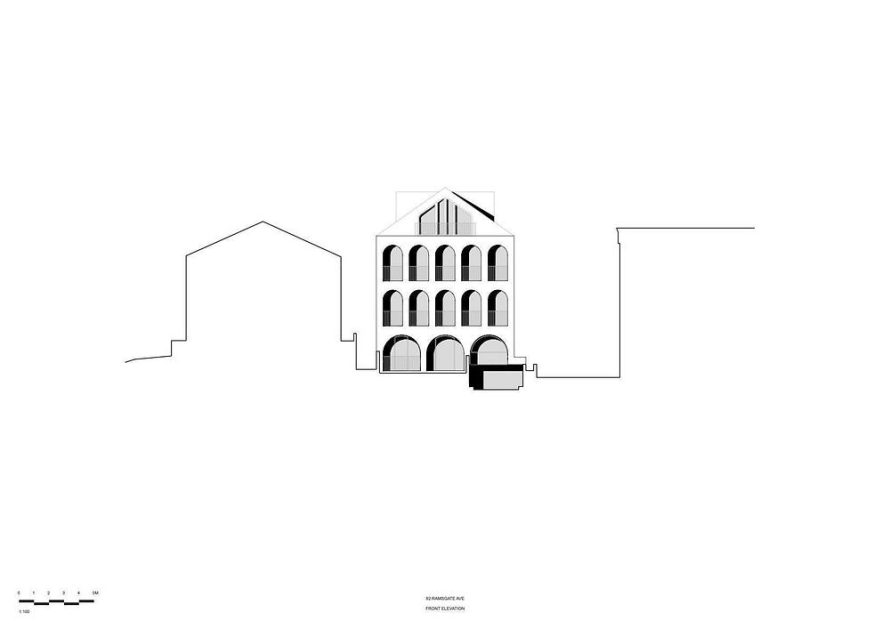
The defining feature of the house is its rhythmic sequence of arches stretching across the primary facade. Rather than functioning as decorative gestures alone, these arches form thickened thresholds that mediate between the public street and the private interior. The design draws inspiration from historical precedents such as the Palazzo della Civiltà Italiana while translating the language of the loggia into a distinctly Australian coastal condition. Humans have apparently spent thousands of years inventing walls, only to realize they still need semi-outdoor spaces to survive sunlight and awkward eye contact.
The architects worked extensively with local authorities to refine the scale, repetition, and spacing of the arches so the building could sit comfortably within the surrounding streetscape. The result feels monumental yet restrained, combining an Art Deco sensibility with contemporary minimalism. The facade establishes a strong street presence without becoming visually aggressive, allowing the house to participate in the public realm while maintaining domestic intimacy.
Brick, Light, and Coastal Climate
The residence is constructed primarily from double-skin brick masonry, with some areas using triple-skin walls to increase thermal performance and acoustic insulation. These thick walls provide depth, shade, and environmental stability, particularly important in Bondi’s exposed coastal setting. The arches themselves operate as load-bearing structural elements, giving the facade both physical weight and sculptural clarity.
Passive environmental strategies are embedded throughout the project. Deep reveals help minimise solar gain, while operable openings support natural cross ventilation. The house avoids excessive technological dependence by relying on orientation, material mass, and spatial buffering to regulate comfort levels naturally. A surprisingly radical idea in 2026, when many buildings behave like giant glass kettles requiring industrial-scale air conditioning just to keep humans from dissolving into humidity.
At the rear of the property, articulated steel-framed windows are set within a textured stucco facade. These openings frame views toward the garden while drawing northern light deep into the interior. Native planting softens the boundary between architecture and landscape, reinforcing the project’s connection to local ecology.
A Vertical Interior Experience
Inside, the geometry of the arch evolves into a flowing vertical sequence centred around a sculptural stairwell. Curved forms guide movement upward through the house while pulling daylight into the deeper levels. This continuous circulation strategy creates visual connectivity between floors and gives the interior a calm, almost cinematic rhythm.
The uppermost level culminates in a copper-clad pavilion overlooking Bondi Beach and the Pacific Ocean. Designed as a gathering space for entertaining, the pavilion introduces a material contrast to the masonry below. Over time, the copper exterior will weather naturally, allowing the building’s appearance to evolve with age and exposure to the coastal atmosphere.
Interior design by Handelsman + Khaw complements the architectural language through muted finishes and durable materials selected specifically for coastal conditions. Sun-washed textures, soft tones, and restrained detailing reinforce the atmosphere of quiet retreat without disconnecting the home from its energetic surroundings.
Architecture Rooted in Place
More than a luxury residence, Ramsgate House demonstrates how historical architectural ideas can be adapted to contemporary urban and environmental conditions. Through its reinterpretation of the classical loggia, the project creates layered relationships between privacy, climate, and public life. The arches become more than formal references; they operate as spatial filters, environmental moderators, and urban mediators.
For Common Office, the project reflects a broader design philosophy centred on clarity, contextual sensitivity, and long-term contribution to urban life. Rather than chasing spectacle, Ramsgate House achieves presence through proportion, material depth, and carefully controlled spatial experience. In a coastal suburb dominated by visibility and tourism, the house quietly argues that good architecture can still create moments of shelter, silence, and permanence.
| Technical Sheet | |
|---|---|
| Project Name | Ramsgate House |
| Architect | Common Office |
| Location | 92 Ramsgate Avenue, Bondi Beach, Sydney NSW 2026, Australia |
| Google Maps | https://maps.google.com/?q=92+Ramsgate+Avenue+Bondi+Beach+Sydney+NSW+2026+Australia |
| Traditional Owners | Bidjigal, Birrabirragal and Gadigal people |
| Project Type | Residential Architecture |
| Floor Area | 516.8 m² |
| Site Area | 477.3 m² |
| Completion Date | 12 December 2025 |
| Lead Architects | Rob Meyerson, William J McKee |
| Project Designer | Michael Cho |
| Graduate Architect | Manuel Hankoo |
| Builder | Ivison Constructions |
| Structural Engineer | ABVD |
| Services Engineer | ERBAS |
| Project Manager | Richard Pajor, Cardo Projects |
| Interior Designer | Handelsman + Khaw |
| Landscape Design | Myles Baldwin Design |
| Planner | GSA Planning |