

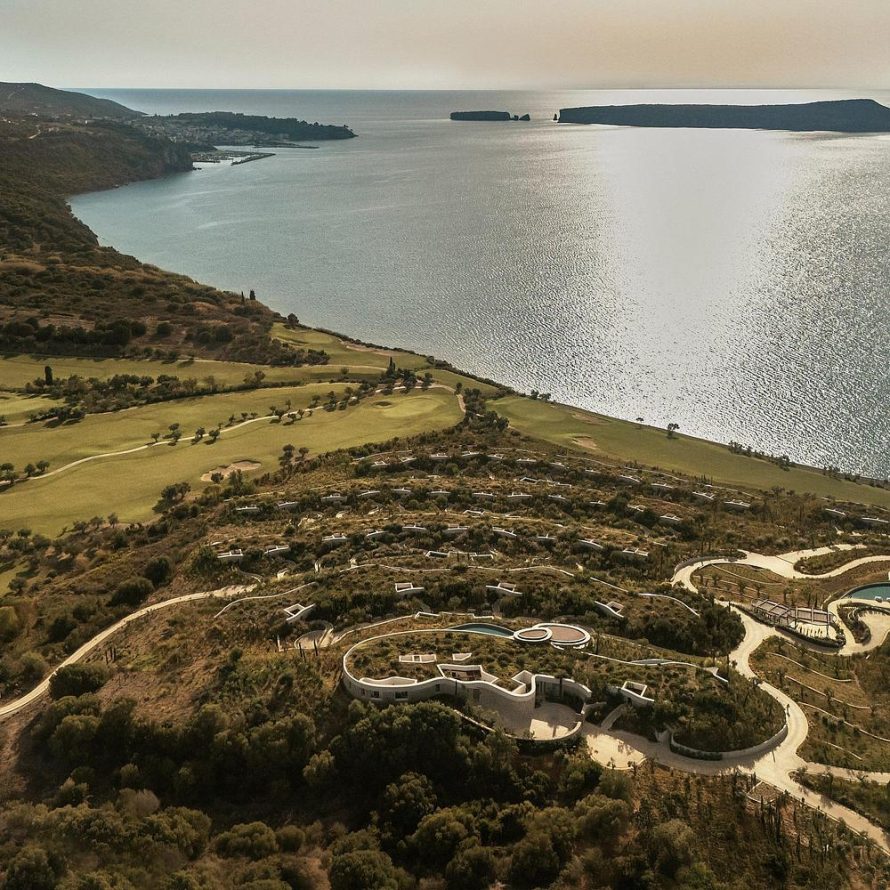

Designed by Alexandros N. Tombazis and Associates Architects S.A. in collaboration with K-Studio, Mandarin Oriental, Costa Navarino offers a refined answer to a familiar resort question: how can luxury hospitality feel deeply rooted rather than simply placed on a beautiful site? Set above the bay of Navarino in the Peloponnese, Greece, the resort balances the expectations of an international hotel brand with a calm architectural language shaped by land, climate, and culture.
The project avoids the usual resort spectacle. Instead of creating one dominant object, the architects developed a dispersed masterplan that follows the contours of the hills. Its accommodation, including 48 earth-sheltered villas with private pools, is organized in clusters that feel more like a contemporary village than a conventional hotel complex.
A Resort Shaped by Rural Greek Memory

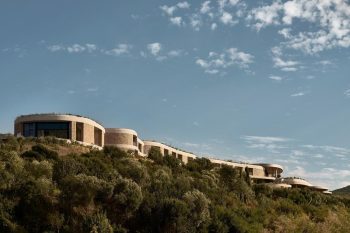
The design draws inspiration from the Greek “mandria,” traditional stone enclosures that adapted naturally to uneven terrain. Rather than copying this rural typology literally, the resort reinterprets it at a larger scale. Stone walls, planted roofs, shaded terraces, and courtyard-like thresholds create a quiet architectural rhythm that feels connected to the Peloponnese landscape.
This approach gives Mandarin Oriental, Costa Navarino a sense of intimacy despite its resort scale. Each villa is positioned to preserve privacy while maintaining meaningful views toward the wider landscape. The result is a spatial experience that feels layered, moving from interior rooms to semi-sheltered outdoor areas and then into open gardens.
Architecture That Works With the Climate
Passive design plays a central role in the guest experience. Deep overhangs, filtered views, cross-ventilation, and thermal mass help temper the Mediterranean climate without relying only on mechanical systems. Outdoor circulation routes reduce the need for cooled corridors, while covered terraces and entry courtyards soften the transition between exterior heat and interior comfort.
The decentralized layout also supports seasonal flexibility. Clusters of rooms and villas can be opened or closed depending on demand, helping optimize energy consumption across the resort. It is a practical move, not the kind of sustainability theatre humans keep printing on brochures while air-conditioning empty corridors.
Material Calm and Mediterranean Texture
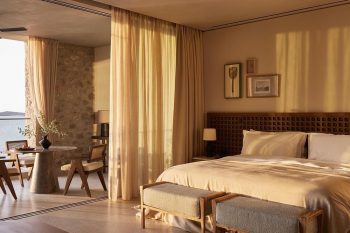
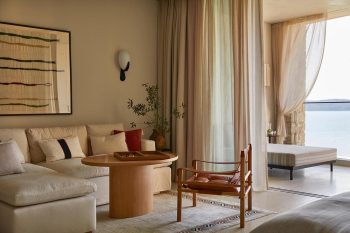
The architectural atmosphere is restrained but not bare. Stone, terrazzo, earthy tones, and tactile finishes create a grounded interior language. The spaces reference Mediterranean textures without falling into theme-park nostalgia. International details are layered carefully, suggesting travel and hospitality while allowing the local setting to remain the main character.
Space planning is intentionally intuitive. Guests can move through the resort with clear orientation, comfortable scale, and repeated contact with gardens, sea views, and open air. The architecture does not shout for attention; it frames moments of shade, breeze, privacy, and horizon.
Landscape as the Main Luxury
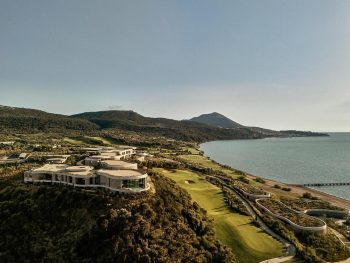

Sustainability is treated as a design structure, not an afterthought. Planted roofs help the buildings merge with the terrain, local materials reduce transport impact, and water-efficient planting responds to the dry Mediterranean environment. Low-impact lighting and energy zoning reinforce the ecological ambition while protecting the quiet character of the site.
Mandarin Oriental, Costa Navarino shows how resort architecture can move beyond image-making. Through the work of Alexandros N. Tombazis and Associates Architects S.A. and K-Studio, the project becomes less about display and more about relationship: between architecture and land, guest and climate, luxury and restraint.
| Technical Sheet | |
|---|---|
| Project Name | Mandarin Oriental, Costa Navarino |
| Location | Costa Navarino, Peloponnese, Greece |
| Architects | Alexandros N. Tombazis and Associates Architects S.A. + K-Studio |
| Typology | Luxury resort, hotel, villas, spa, pool, landscape architecture |
| Design Concept | Decentralized resort village inspired by Greek rural mandria stone enclosures |
| Key Accommodation | 48 earth-sheltered private villas with pools |
| Landscape Strategy | Clustered buildings following the natural contours of the hills |
| Primary Materials | Stone, terrazzo, planted roofs, Mediterranean-inspired finishes |
| Passive Design | Thermal mass, cross-ventilation, shaded terraces, deep openings, outdoor circulation |
| Sustainability Features | Water-efficient landscaping, local materials where possible, low-impact lighting, energy zoning |
| Recognition | Architecture Masterprize 2025, AHEAD Europe Awards 2025, LIV Awards 2025, EU Mies Awards 2026 nominee |