

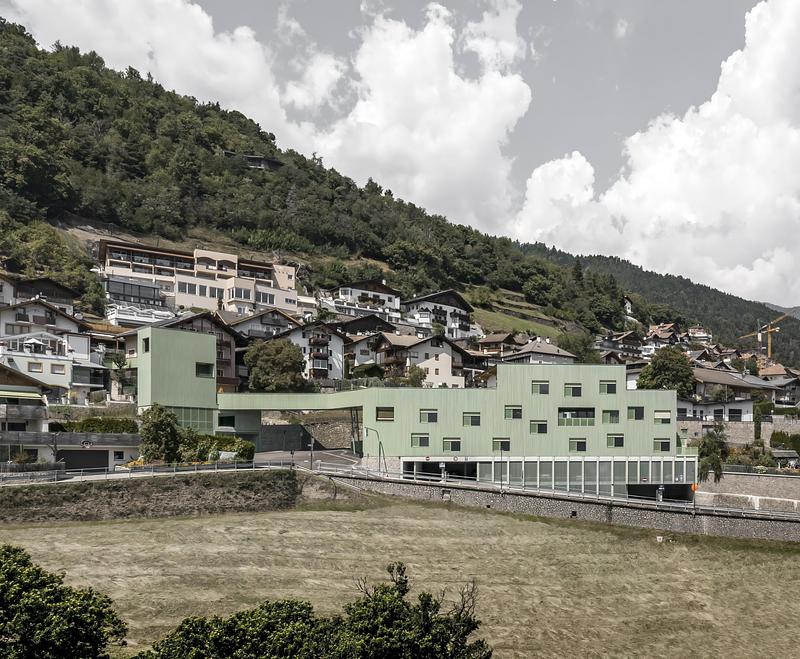

At the southern gateway of Barbiano in South Tyrol, Roland Baldi Architects has completed a multifunctional public complex that redefines how rural communities can combine education, mobility, and tourism infrastructure within a single architectural vision. Designed as part of Italy’s Recovery and Resilience Plan, the project introduces a contemporary civic hub that strengthens community connections while responding sensitively to the region’s distinctive landscape. More than a collection of public facilities, the development establishes a new rural landmark that supports everyday life and long-term growth.
A Unified Vision Across Two Buildings
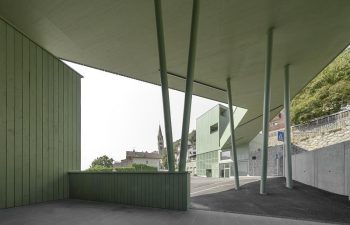

The project is organized into two separate structures positioned on opposite sides of the road. On the hillside, the main building accommodates a kindergarten, daycare center, children’s restaurant, and protected outdoor play spaces. Across the street, a second building houses the tourist office and public amenities, creating a complementary relationship between community services and visitor infrastructure.
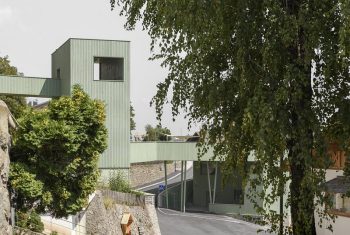
A defining feature of the scheme is the elevated bridge linking the two buildings. More than a circulation element, the bridge serves as a visual symbol of connection, integrating the various functions into a cohesive public destination. Together, the buildings create a seamless interface between residents, visitors, and the surrounding village fabric.
Designing Spaces for Contemporary Learning

The educational facilities were conceived to support modern approaches to childhood development. Instead of relying on traditional classroom layouts, the interiors are organized around flexible and interconnected learning environments. Dedicated zones for creativity, exploration, quiet reflection, and social interaction encourage children to engage with their surroundings in multiple ways.
Wide circulation areas expand into informal gathering points, creating opportunities for spontaneous interaction and play. The children’s restaurant and kitchen not only serve the facility itself but also provide meals for the neighboring primary school, reinforcing the building’s role as a broader community resource.
Landscape and Topography as Architectural Drivers
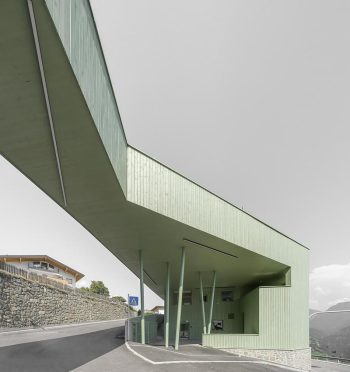

The steep terrain played a central role in shaping the architectural concept. Rather than resisting the site’s natural conditions, the design embraces the slope through a layered arrangement of functions. Technical facilities occupy the lower levels, educational spaces are positioned above, and a protected rooftop playground crowns the structure.
A robust exposed concrete base anchors the complex to the hillside, while a lightweight timber superstructure reduces visual mass and environmental impact. The vertically articulated green timber facade provides a distinctive identity, allowing the building to stand out as a recognizable feature at the entrance to Barbiano while remaining connected to the surrounding landscape.
Sustainable Infrastructure for Rural Communities
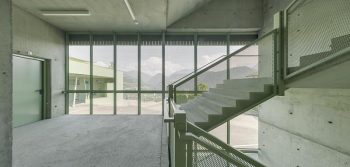

Environmental performance was a key priority throughout the project. Built to the Climate House Gold standard, the complex incorporates photovoltaic panels, heat-pump technology, and controlled ventilation systems with heat recovery. These measures contribute to a highly efficient building that supports both sustainability goals and long-term operational performance.
Natural materials further enhance the user experience. Local wood, daylight-filled interiors, solid timber furnishings, and acoustic wooden ceilings create a calm and welcoming environment. Through these carefully considered design decisions, the project demonstrates how sustainable architecture can elevate public services while strengthening community identity.
With this ambitious development, Roland Baldi Architects has transformed a complex program into a cohesive civic destination. By combining educational facilities, accessible mobility infrastructure, and tourism services within a single architectural framework, the project establishes a forward-looking model for rural development. The result is a meaningful public place that enriches daily life while reinforcing the connection between people, architecture, and landscape.
Technical Sheet
| Category | Details |
|---|---|
| Project Name | Multifunctional Building in Barbiano |
| Location | Barbian/Barbiano, South Tyrol, Italy |
| Google Maps | View Location |
| Client | Municipality of Barbian/Barbiano |
| Architect | Roland Baldi Architects |
| Project Team | Roland Baldi, Sila Giriftinoglu, Erica Mazzoni |
| Structural Engineering | Bauburo |
| Mechanical Engineering | Energytech |
| Electrical Engineering | Energytech |
| Security Coordination | Pfeifer Partners |
| Gross Floor Area | 1,587.35 m² |
| Built Volume | 6,244.98 m³ |
| Construction Start | 26 March 2023 |
| Construction Completion | 31 August 2025 |
| Photos | Oskar Da Riz |