

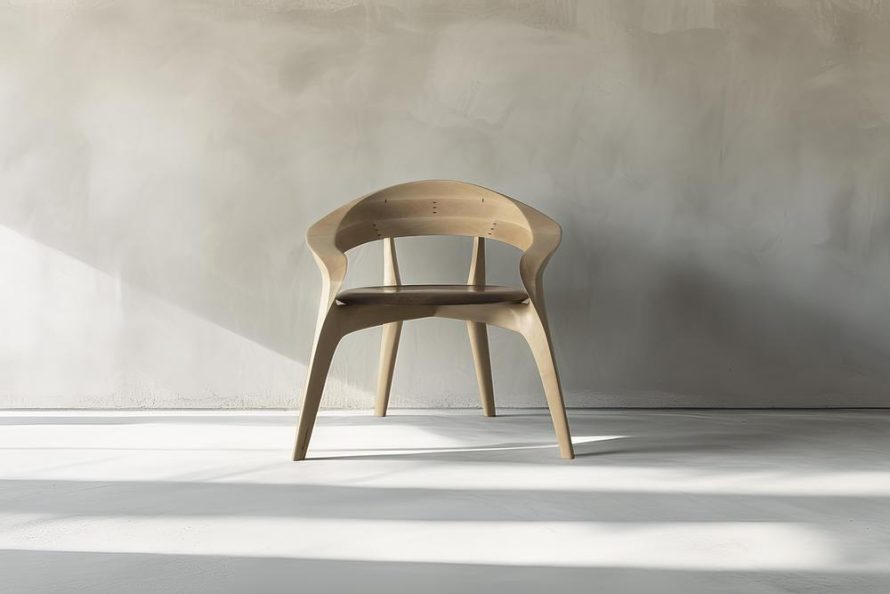

Yedit is bringing ORUHA, its award-winning sculptural wooden chair, closer to public release after years as an acclaimed prototype. Designed by Yuya Nakazawa in Shinjuku, Tokyo, the chair has earned ten international design honors and entered the Permanent Collection of the Museum of Outstanding Design. Its transition toward limited production reflects an effort to preserve handcrafted quality while making the piece available beyond exhibitions and awards programs.
From Shared Workshop to Collectible Furniture
ORUHA was originally made in a rented workshop, where restricted space complicated production, storage, and international shipping. These practical limitations kept the chair unavailable to buyers even as it gained recognition from juries in Europe, Asia, and the United States. The situation reveals a familiar challenge for independent furniture designers: moving from an experimental prototype to small-scale production without losing the qualities that made the original distinctive.
To support that transition, Yedit is preparing a dedicated studio in Shinjuku and introducing an atelier-based production system. An official waiting list and preview channels now provide an initial connection with an international audience. Rather than treating ORUHA as a conventional mass-produced chair, the brand is positioning each piece within a slower process shaped by available workshop capacity and detailed manual finishing.
A Chair That Creates a Personal Place
ORUHA was conceived as more than a seat. Its curved wooden body forms a partially enclosing presence around the user, creating a subtle feeling of separation within lounges, galleries, hotels, or other shared interiors. The design does not depend on walls or partitions; instead, its sculptural silhouette defines a small personal zone through scale, orientation, and visual weight.
This spatial role is balanced with the practical demands of furniture. Measuring 740 mm wide, 550 mm deep, and 760 mm high, ORUHA combines a hard maple body with a contrasting walnut seat. Broad organic surfaces give the chair a substantial identity, while carefully controlled proportions maintain visual lightness and everyday comfort. Changes in natural and artificial light also reveal different edges, shadows, and wood-grain patterns across its form.
Film Editing Translated Into Wood
Nakazawa developed ORUHA through ideas drawn from his experience editing television commercials and other visual productions. Film editors arrange separate scenes to create rhythm, continuity, and emotional progression. Here, that method is translated into furniture through the sequence of lines, surfaces, and proportions encountered as someone approaches, observes, and finally sits in the chair.
The result is not a literal reference to cinema but a compositional method. Each wooden element contributes to the overall visual flow, much like an edited scene supports a larger narrative. This approach gives the chair a clear identity from multiple viewpoints, allowing it to operate as both functional furniture and an independent spatial object.
Traditional Craft Within a Limited Release
ORUHA is refined with traditional Japanese woodworking tools, including the kanna hand plane. Manual shaping helps soften transitions between surfaces and gives the maple structure a more responsive relationship with light. The process also supports small variations between pieces, reinforcing the character of atelier-made furniture rather than aiming for complete industrial uniformity.
The chair’s ten honors include Gold at the 2026 A’ Design Award and Best in Category at the 2025 London International Creative Competition. It has also received awards in Tokyo, Paris, Rome, London, France, New York, and across Asia. With no public price announced, the current waiting-list rollout serves as the first stage toward limited availability. For Yedit and designer Yuya Nakazawa, ORUHA’s next chapter will test how a museum-recognized design can enter private and public interiors while retaining its original craft-led identity.
| ORUHA Chair Technical Specifications | |
|---|---|
| Product | ORUHA Chair |
| Designer | Yuya Nakazawa |
| Brand | Yedit |
| Category | Furniture and Product Design |
| Type | Sculptural wooden chair |
| Dimensions | W740 x D550 x H760 mm |
| Seat Height | 430 mm |
| Materials | Hard maple body and walnut seat |
| Finish | Hand-finished using traditional Japanese woodworking tools |
| Production Status | Waiting-list rollout ahead of limited production |
| Major Honors | Ten international design awards, including A’ Design Award Gold and LICC Best in Category |
| Museum Collection | Museum of Outstanding Design Permanent Collection |
| Location | Shinjuku, Tokyo, Japan |
| Country of Origin | Japan |