

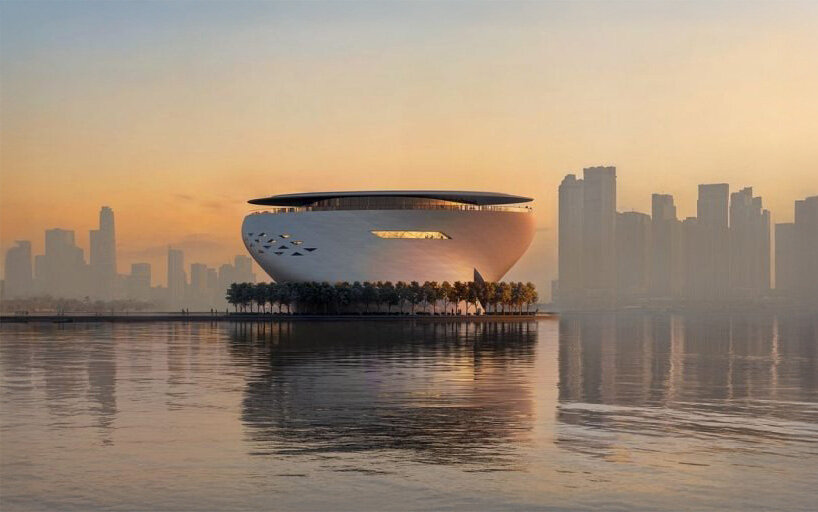

At the edge of Dubai Creek, Tadao Ando is preparing a new cultural landmark that turns architecture into a quiet encounter between water, light, and art. The upcoming Dubai Museum of Art, also known as DUMA, is planned as a sculptural building set on a circular platform above the creek, giving the impression of a museum floating between the city and the sea.
The project carries many of Ando’s familiar architectural themes, but it adapts them to a very specific Dubai condition. Instead of simply placing a concrete object beside the water, the design uses the creek as part of the museum’s presence. Its rounded body, smooth white surface, and twisting silhouette suggest a vessel, a pearl, and a monolithic sculpture at once.
A Floating Form for a Maritime City
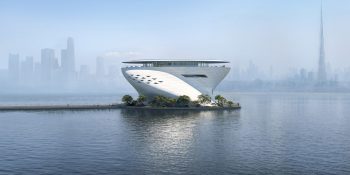

The museum is conceived as a rounded structure rising from a platform surrounded by water. From across the bay, its curved profile appears calm but not static. The building folds upward toward a glazed opening, creating a sense of motion without relying on decorative excess. It is classic Ando restraint, though this time with a more fluid and maritime character.
This relationship with Dubai Creek is important. The creek has long shaped the city’s identity as a place of trade, movement, and exchange. By positioning the museum on the water, the design links contemporary art with Dubai’s older urban memory. The result is not a nostalgic gesture, but a carefully controlled architectural image: a cultural institution that seems to hover at the threshold between history and future.
Concrete, Geometry, and Desert Light
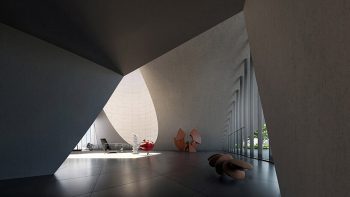

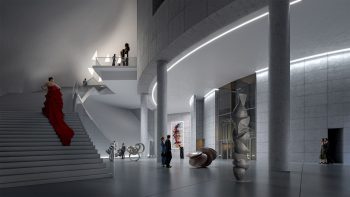
Inside, DUMA is organized around the familiar Ando language of concrete and geometry. The first two levels are planned for galleries, shaped around a central oculus that draws daylight down into the interior. Rather than flooding the space with brightness, the opening is expected to create a soft, pearlescent glow that changes through the day.
Triangular apertures puncture the smooth exterior surface, filtering light into the museum while adding rhythm to the facade. These openings help break the mass of the building without making it visually noisy. In Dubai’s sharp sunlight, this becomes more than a formal move. It turns the facade into a calibrated surface, where shadow, glare, and reflection become part of the visitor experience.
Spaces for Viewing, Learning, and Gathering
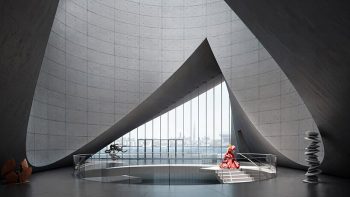
Beyond exhibition galleries, the Dubai Museum of Art is planned to include a library, study areas, a lounge, and a restaurant. This wider program suggests that the museum is not being designed only as a container for artworks. It is also intended as a place for research, informal meetings, public programs, and cultural exchange.
The upper level will frame views across the creek toward Dubai’s skyline. This gives the museum a dual role: inwardly focused on art, and outwardly connected to the city. The architecture does not isolate visitors from Dubai’s urban energy. Instead, it pauses that energy, frames it, and asks people to look at it again. A shocking concept, apparently: buildings can make people slow down.
A Quiet Landmark in a Fast City
Dubai is often associated with height, spectacle, and rapid development, but DUMA proposes a different kind of landmark. Its impact comes less from vertical drama and more from atmosphere, proportion, and the way it meets the water. The museum’s calm white mass may become especially expressive at sunset, when the surface catches the amber tones of the sky.
For Tadao Ando, the Dubai Museum of Art extends a long investigation into silence, light, and spatial sequence. For Dubai, it adds a cultural building that speaks through restraint rather than pure spectacle. When completed, DUMA could become not only a home for modern and contemporary art, but also a new architectural marker on Dubai Creek, shaped by Tadao Ando’s ability to make stillness feel monumental.
| Technical Sheet | |
|---|---|
| Project Name | Dubai Museum of Art (DUMA) |
| Architect | Tadao Ando |
| Location | Dubai Creek, Dubai, UAE |
| Client / Developer | Al-Futtaim Group |
| Project Type | Art Museum, Cultural Institution |
| Main Program | Exhibition galleries, library, study areas, lounge, restaurant |
| Key Architectural Elements | Floating circular platform, central oculus, curved concrete volumes, triangular apertures |
| Visualizations | Al-Futtaim Group |
| Status | Planned / Unveiled |