

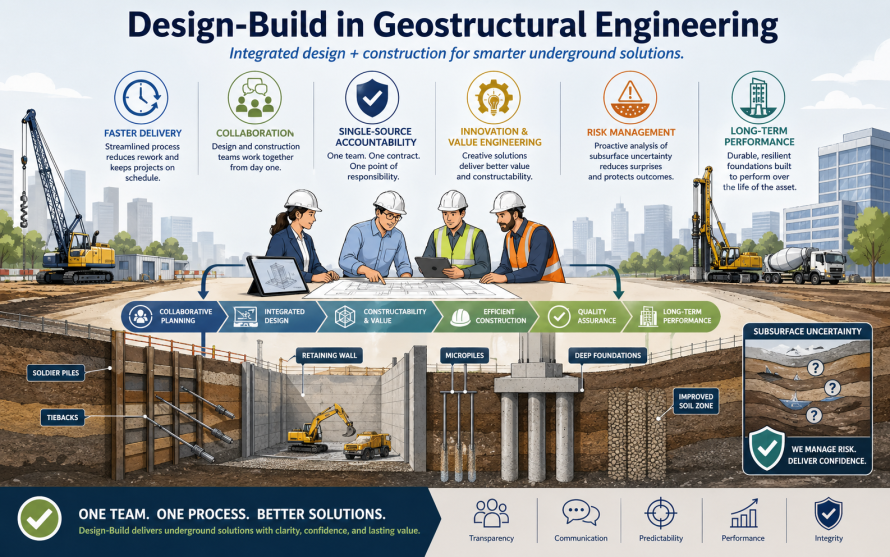

When complex underground and foundation challenges arise on a project site, the delivery method chosen can be just as consequential as the engineering itself. The geostructural design build approach — in which a single entity is responsible for both the design and construction of geotechnical and structural elements — has gained considerable traction across the civil and infrastructure industry. And for good reason. From retaining walls and soldier pile systems to tiebacks, micropiles, and ground improvement, geostructural work is uniquely suited to benefit from the integrated nature of design-build delivery. Here’s why.
What Is Design-Build in the Geostructural Context?
Before diving into the benefits, it’s worth clarifying what design-build actually means in this niche but critical field.
In a traditional design-bid-build model, an owner hires a designer to produce a set of plans and specifications, then puts that work out to competitive bid. The contractor who wins the bid builds to those plans — often with minimal interaction with the engineer of record. If conditions in the field don’t match what was assumed during design, the process of resolving conflicts can be slow, contentious, and expensive.
In a design-build model, a single firm — or a tightly integrated team — handles both the engineering and the construction. In geostructural engineering specifically, this is a particularly natural fit. Geostructural work involves soil-structure interaction, often in challenging subsurface conditions that aren’t fully known until construction begins. The ability to have the designer and builder working in lockstep is not just a convenience; it’s often a technical necessity.
Benefit #1: Faster Project Delivery
One of the most commonly cited advantages of design-build is schedule compression. Because design and construction activities can overlap — a process sometimes called “fast-tracking” — projects can move from concept to completion more quickly than in a sequential design-bid-build process.
In geostructural projects, this is especially valuable. Deep foundation systems, earth retention, and ground improvement often sit on the critical path of a larger construction program. Delays in these foundational elements cascade across every subsequent trade. When the design-builder can begin mobilizing equipment and procuring materials while finalizing design details, weeks or even months can be trimmed from the schedule.
Consider a project that requires a tieback retaining wall to support an excavation for a below-grade parking structure. In a traditional delivery, the wall design must be fully complete and permitted before a contractor is brought on board. With design-build, the contractor’s field crews can be installing the first row of soldier piles while wall geometry and tieback layouts are still being refined for the lower lifts — all with the engineer directly involved in real time.
Benefit #2: Improved Communication and Collaboration
Geostructural engineering requires constant, fluid communication between the people producing the drawings and the people in the ground making it happen. Subsurface conditions are inherently variable. Even with thorough geotechnical investigation — borings, lab testing, in-situ testing — what a drill encounters during installation often differs from what was modeled.
In a design-bid-build project, a field discrepancy typically requires a formal Request for Information (RFI), a response from the designer, potential re-engineering, and contract modification before work can proceed. Each handoff introduces delay and the potential for miscommunication.
In a design-build setting, the engineer and the field superintendent are often a phone call — or a short drive — apart. When a driller hits an unexpected lens of soft material or a cobble layer that slows production, the design team can assess the condition, make an engineering judgment, and adjust the approach in real time. This responsiveness doesn’t just save time; it often results in a better-engineered solution because the decision is made by someone who understands both the structural requirements and the construction realities.
Benefit #3: Single-Source Accountability
One of the persistent challenges in geostructural projects delivered under traditional models is the question of who is responsible when something goes wrong. If a retaining wall deflects more than anticipated, is it a design problem or a construction problem? Did the contractor deviate from the plans? Did the plans fail to account for actual soil conditions? The finger-pointing that can ensue in these situations is costly for everyone — especially the owner.
Design-build eliminates that ambiguity. There is one entity responsible for both the engineering and the execution. If the wall deflects, the design-builder owns the problem and is accountable for the solution. This doesn’t mean problems don’t occur — geostructural work is complex, and no delivery method is risk-free — but it does mean the path to resolution is cleaner and faster.
For project owners, this single point of accountability simplifies contract management, reduces legal exposure, and provides greater peace of mind throughout the project lifecycle.
Benefit #4: Value Engineering and Innovation
When the engineer and the contractor are the same team, there is a natural incentive to find the most efficient solution — not just the one that meets the minimum specification. In traditional delivery, a contractor may see a more efficient approach but has no mechanism to modify a design they had no part in creating. The design is the design.
In a design-build environment, the team has both the authority and the motivation to optimize. This might mean substituting a more economical anchor system, adjusting pile spacing based on actual soil response, or selecting specialty equipment better suited to site constraints. These aren’t shortcuts — they’re informed engineering decisions made by people who understand both the technical and field contexts.
This kind of integrated value engineering often produces systems that perform better, cost less, and are easier to build — because they were designed with constructability in mind from the start.
Benefit #5: Better Risk Management for Subsurface Uncertainty
Subsurface risk is the defining challenge of geostructural engineering. Unlike structural steel or concrete work, where materials and conditions are largely known in advance, work below grade involves navigating conditions that are inferred, estimated, and sometimes discovered only during construction.
In a design-bid-build model, the geotechnical report and design drawings are the primary mechanism for communicating subsurface risk. If those documents don’t fully capture the variability of the site — and they often can’t — the contractor is left holding risk they may not have priced adequately, and the owner faces change orders.
Design-build firms that specialize in geostructural work bring field experience directly into the risk assessment process. Because they’ve built in similar conditions before, they have a calibrated sense of what the subsurface data is actually telling them. They build contingencies into their approach, not just their budget. And when conditions change, they have the authority and the expertise to adapt without waiting for someone else’s approval.
Benefit #6: Long-Term Performance and Institutional Knowledge
There is a less obvious but meaningful benefit to design-build that often goes unmentioned: the team that designed the system is the same team that built it. That institutional knowledge has value long after the project is complete.
If an owner later wants to know why a particular micropile configuration was chosen, why the anchor loads were set at a specific value, or how a design was modified in the field to address an unexpected condition — the design-builder has that context. There is no gap between what the designer intended and what the contractor actually did, because they are the same entity.
This continuity is particularly valuable for infrastructure and facilities that may need to be expanded, modified, or maintained over decades.
When Is Design-Build the Right Choice for Geostructural Work?
Design-build isn’t the right fit for every project. Public procurement regulations sometimes require competitive bidding. Projects with well-characterized subsurface conditions and clear, stable scope may not need the flexibility that design-build provides. And some owners prefer the independent check that comes from having separate design and construction entities.
But for projects that involve:
- Significant subsurface uncertainty requiring adaptive design
- Tight schedules where design and construction must overlap
- Complex soil-structure interaction that demands close coordination
- Technically specialized work such as micropiles, ground anchors, soil mixing, or deep soil stabilization
- Urban or constrained sites where field conditions are difficult to predict
…design-build is often the most efficient and effective delivery method available.
Conclusion
The design-build model isn’t a new idea, but its application in geostructural engineering represents a particularly well-suited pairing of delivery method and technical discipline. The inherent uncertainty of subsurface conditions, the need for real-time engineering judgment, and the complexity of soil-structure interaction all make the integrated design-build approach not just advantageous — but often the smartest way to execute this type of work.
For project owners navigating foundation challenges, earth retention needs, or ground improvement requirements, understanding the potential benefits of design-build delivery is a meaningful first step in project planning. The method won’t eliminate the complexity of working below grade, but it can fundamentally change how that complexity is managed — and who bears the responsibility for managing it well.