

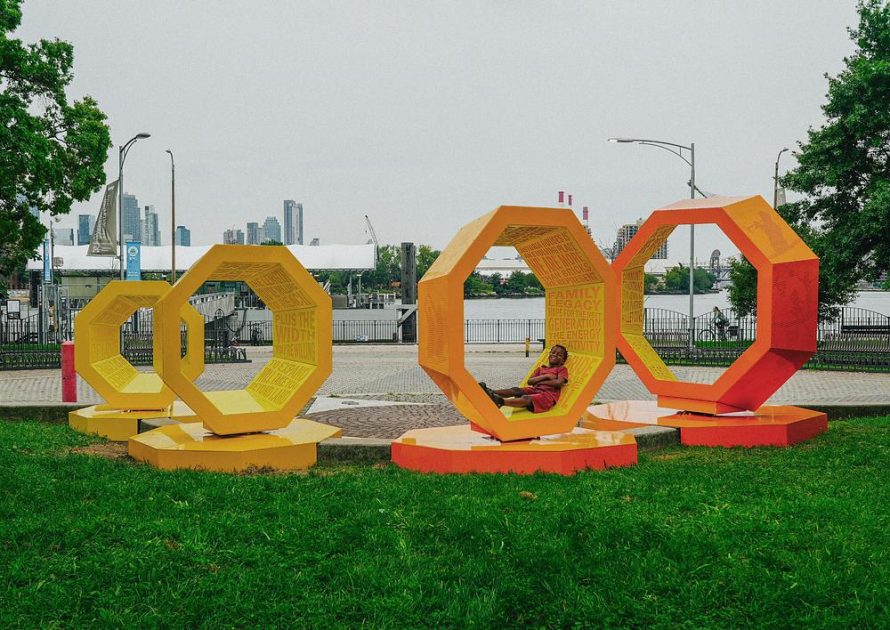

At the edge of Astoria Houses in Queens, New York, The Urban Conga has turned a waterfront pass-through into a place to stop, sit, and encounter neighborhood stories. Created with resident poet Tamra Cosby, Revolving Voices is a permanent public artwork made from four rotating sculptural components. Completed in August 2026, it brings poetry, play, and performance into the same everyday setting beside the Astoria ferry dock.
A Megaphone Reworked as Public Space
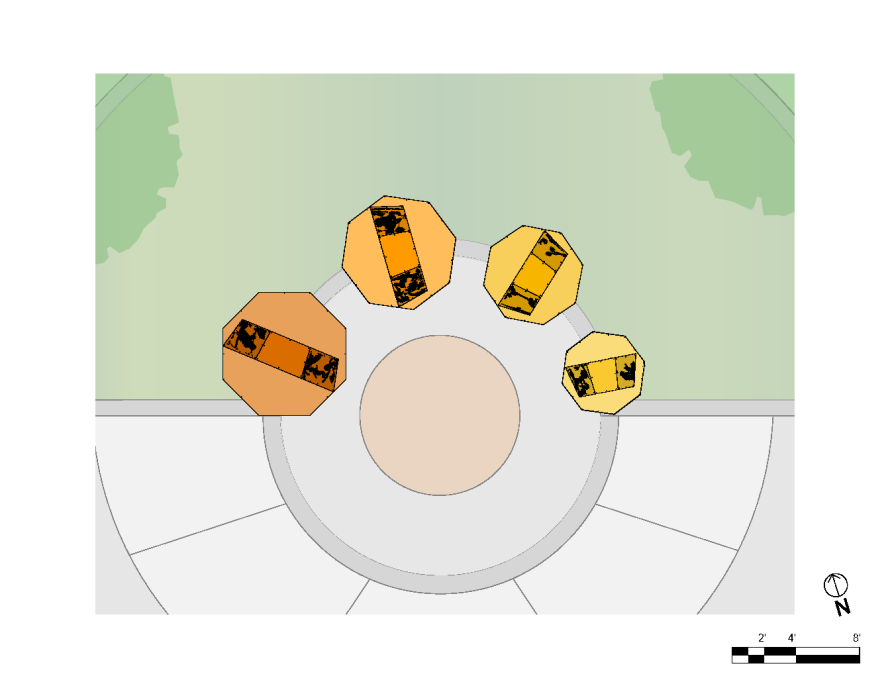

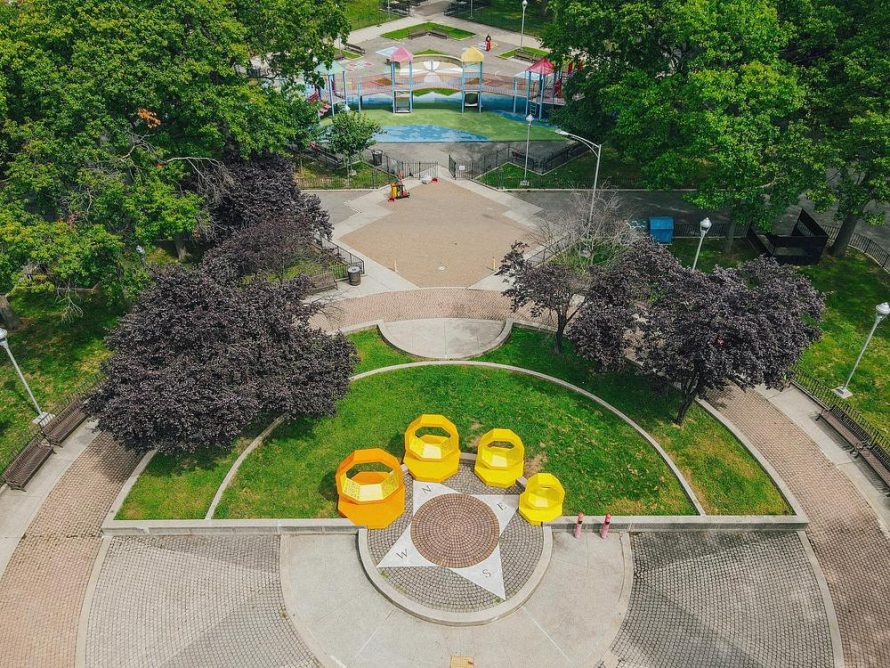
The design begins with a recognizable object: the megaphone. Its association with projecting a voice becomes a spatial idea, translated into four large octagonal forms that decrease in size along the curve of a performance area. Separating that familiar outline into individual pieces creates room for people to enter, occupy, and move between them.
Made from powder-coated aluminum, the components operate somewhere between sculpture and public furniture. People can sit inside, climb, explore, or use the surrounding area to gather. Their success as a gathering place depends on these ordinary activities as much as their presence on the waterfront: a pause during a walk matters alongside an organized performance.
Community Stories at Two Viewing Distances
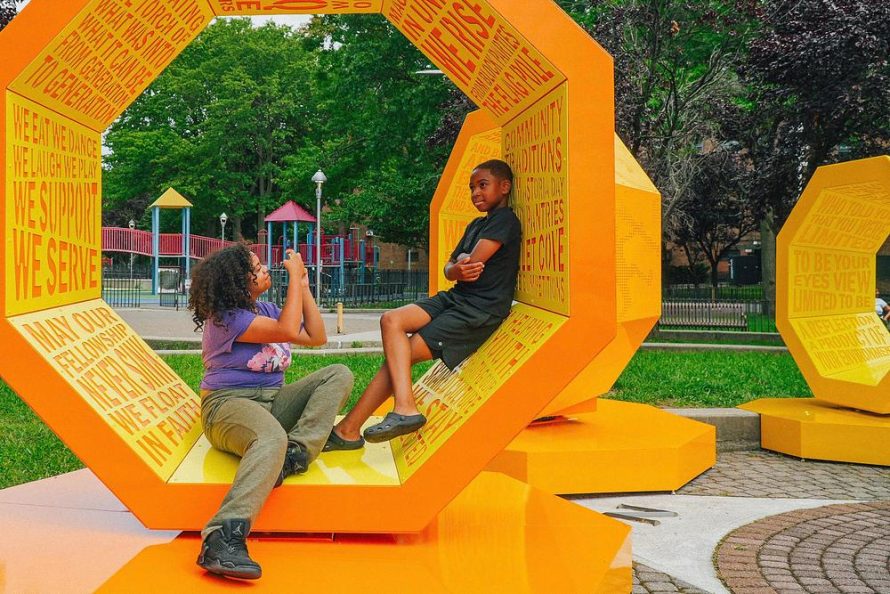

The outer shells carry perforated imagery depicting community life, including playing, dancing, and protesting. Read from a distance, these images give the installation a public-facing layer that connects its abstract geometry to the people who live nearby. The surfaces make local experience part of the artwork’s visible identity.
Inside, the encounter becomes more personal. Etched poetry and memories from Cosby and other residents cover the metal panels, surrounding visitors with words they can read while seated. This change in scale rewards a closer look: the work first attracts attention as a group of objects, then offers stories that require time and proximity.
Rotation Changes the Waterfront Relationship
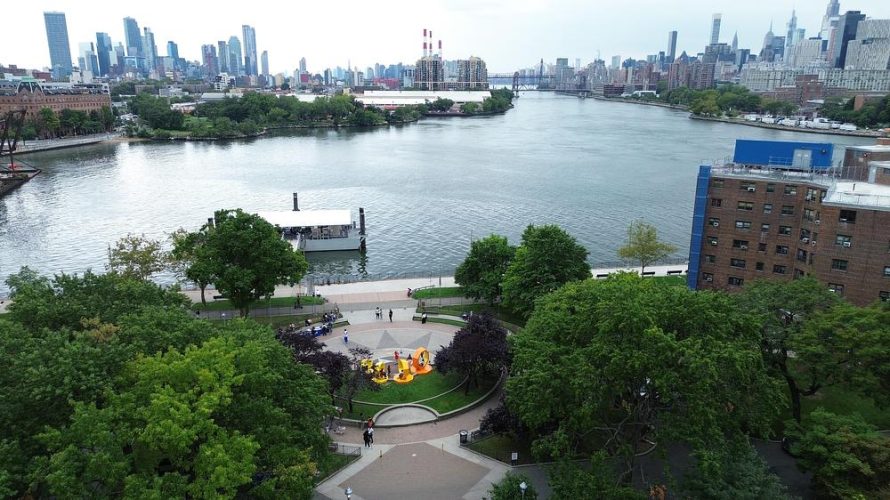

Each component can be manually rotated, allowing users to change its orientation and the views it frames. Turned toward the water, the forms address people arriving or passing along the waterfront. Turned inward, they establish a closer relationship with Astoria Houses and the community whose contributions shaped the installation.
This movement gives visitors a direct role in arranging the space. A different orientation can redirect attention toward a neighbor, a performance, or the surrounding landscape. The rotating forms make the megaphone metaphor tangible: residents can help determine where their stories face, while the artwork remains open to repeated interpretation.
Resident Participation Shapes a Lasting Landmark

The project grew from community engagement sessions within From Roots to Arts, an artist-in-residence program developed by the Public Housing Community Fund and New York City Housing Authority. Cosby’s involvement as both poet and resident connected the design process to local memories, talents, and expectations for the site.
For The Urban Conga, working with Tamra Cosby makes participation part of both the design process and the finished experience. Revolving Voices provides a setting for informal conversation, quiet reading, poetry, and music. Its most compelling contribution is the link between those uses: neighborhood stories occupy a prominent public location, and residents can keep reshaping how people encounter them.
| Item | Details |
|---|---|
| Project | Revolving Voices |
| Location | Astoria Houses, 4-25 Astoria Blvd, Astoria, NY 11102, New York, United States. View project address on Google Maps |
| Lead designer / creator | The Urban Conga |
| Design collaborator / local poet | Tamra Cosby |
| Firm leads | Ryan Swanson and Maeghann Coleman |
| Clients | New York City Housing Authority and Public Housing Community Fund |
| Initiative | From Roots to Arts: Celebrating NYCHA’s Cultural Heritage |
| Completion | August 2026 |
| Type | Permanent interactive public artwork and gathering space |
| Material | Powder-coated aluminum |
| Reported area | Approximately 140 sq ft (13 sq m) |
| Components | Four manually rotating pieces |
| Dimensions | Pieces range from 4 ft 8 in to 7 ft 8 in in diameter and height (approximately 1.42-2.34 m) |