

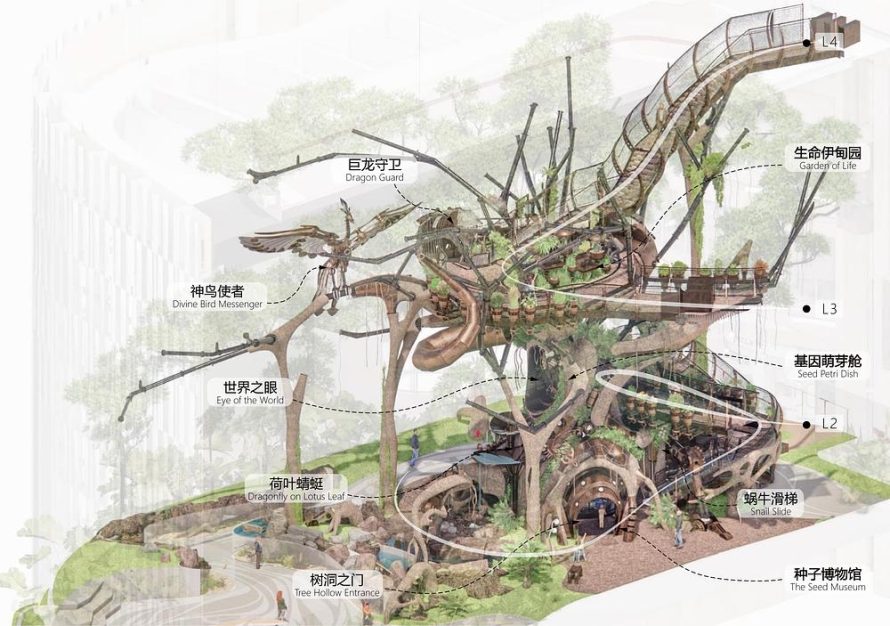

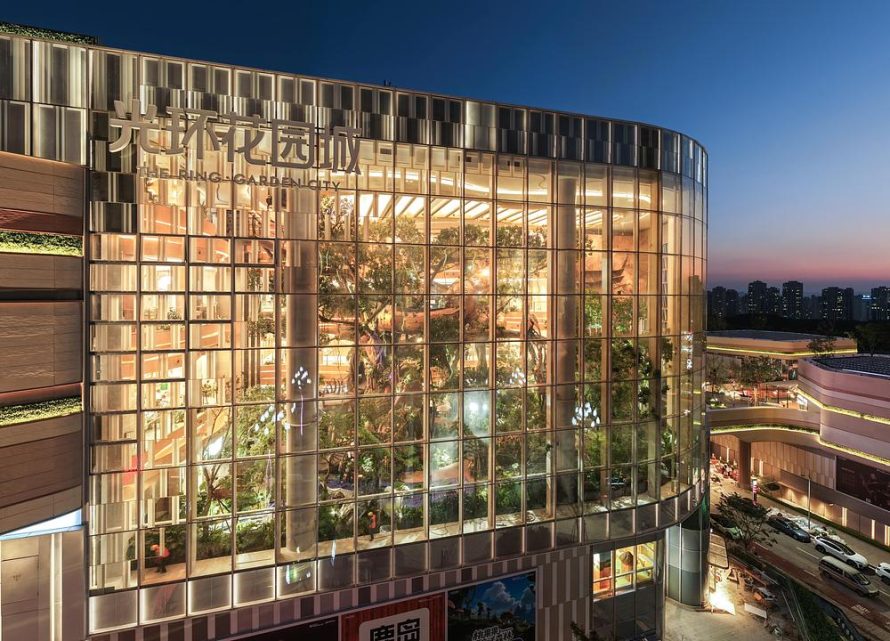
Rising through the commercial atrium of THE RING GARDEN CITY in Chongqing, China, Wonder Tree is a 20.5-meter-high installation designed by XISUI Design. The project combines a steampunk forest, indoor landscape, exhibition space, and participatory playground within a four-level retail environment covering more than 4,000 square meters.
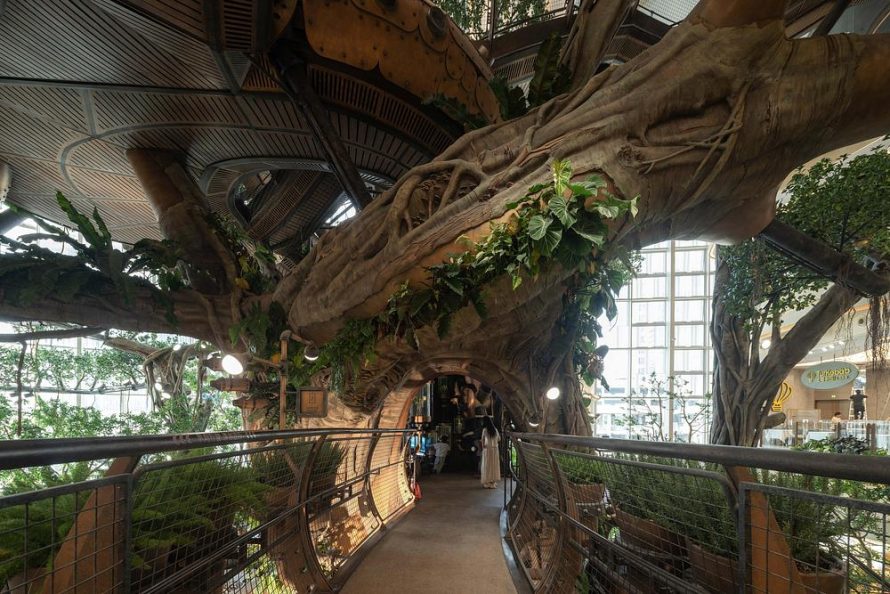
Rather than treating the atrium as an empty circulation void, the installation turns it into a vertically connected destination. Visitors can enter the mechanical tree, follow elevated walkways, encounter planted environments, and interact with displays that interpret the relationship between technology and the natural world.
A Vertical Forest Built Around a Mechanical Tree
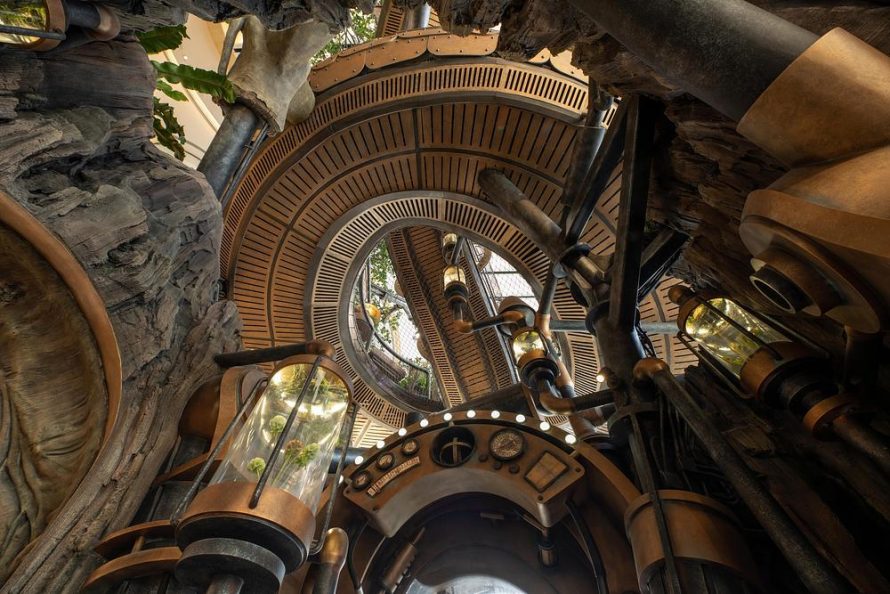

The design imagines the Wonder Tree as a living machine capable of traveling across the planet and restoring damaged ecosystems. Metallic pipes, exposed joints, mechanical roots, and copper-toned surfaces are interwoven with more than 200 varieties of fantastical plants, creating a three-dimensional landscape that extends from the water feature to the upper canopy.
This fictional framework gives visual and educational purpose to each level. The ground floor becomes a Seed Museum and energy core, while the second level contains the Gene Cabin, an imagined laboratory where vulnerable seeds are cultivated. Higher in the canopy, the Eden of Lives offers a larger activity platform where plants grow within a more open environment.
Interactive Ecology and Environmental Storytelling

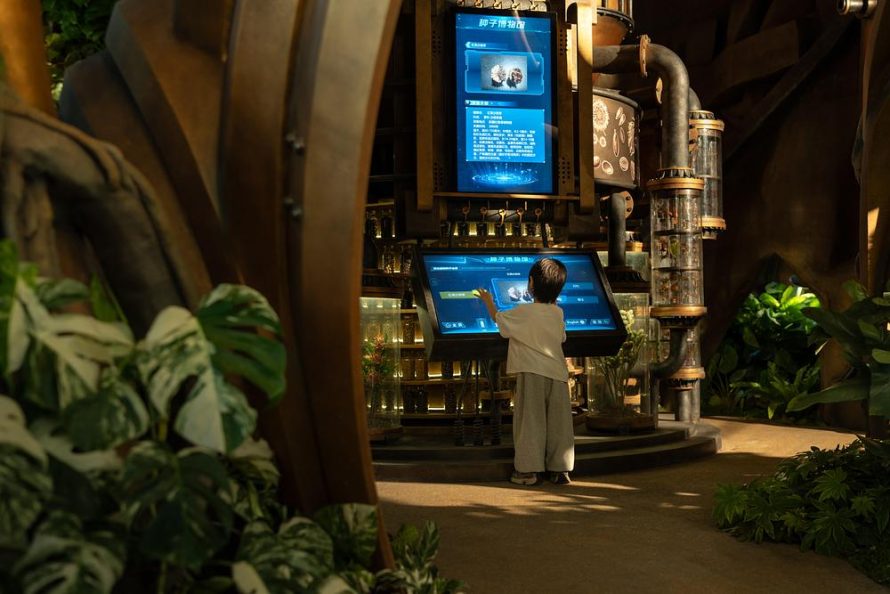
The Seed Museum was developed with Chongqing Natural History Museum, which collected hundreds of seed species from regions including Heilongjiang, Ningxia, the Greater Khingan Range, and Xishuangbanna. Touchscreens allow visitors to select individual seeds, activate educational media, and illuminate specimens inside rotating storage tanks.
Elsewhere, the water purification system transforms environmental processes into interactive exhibits. Mechanical roots appear to draw in polluted water before centrifugal separation, filtration, microbial treatment, aeration, and sterilization. Visitors can trigger spinning machinery, colored lighting, bubbling tanks, and mist effects to understand how each stage contributes to the fictional closed-loop system.
Axial fans, grow lights, irrigation lines, and electrical services are integrated into the tree’s pipeline network. These functional components support air movement and plant health while also reinforcing the installation’s industrial visual language.
Mechanical Creatures Become Part of the Architecture
A family of oversized creatures gives the installation a playful identity. A five-meter-tall mechanical snail functions as a children’s play structure with a spiral stair, periscope, and cylindrical slide. Its turbine-like shell, tracked foot, rocket thrusters, and aviator equipment humorously contrast machinery with the animal’s naturally slow movement.
A mechanical dragonfly is presented as a flying maintenance technician, while a six-meter-tall Divine Bird acts as a scout. The Great Loong Guardian coils around the tree and performs a practical architectural role: its body forms the outer guardrail panels along the three-level sightseeing walkway. Circular windows allow younger visitors to observe the atrium safely.
Digital Engineering Supports the Fantasy
Behind the theatrical appearance is a carefully coordinated structural system. A concealed core column supports the trunk, while mechanical roots provide balance at ground level. Aerial roots stabilize extending branches, and selected elements are suspended from the atrium’s ceiling beams to reduce the installation’s footprint.
The tree’s branching system was algorithmically generated to combine natural growth patterns with circulation, functional zoning, structural loads, and the placement of planted clusters. Prefabricated flange plates, branching joints, and diameter-transition nodes allowed major steel components to be manufactured off-site and assembled within the commercial atrium.
Completed in September 2025 after approximately four years of design and construction, Wonder Tree demonstrates how an atrium installation can connect retail frontage with public recreation, environmental education, and urban spectacle. Through extensive coordination with landscape, structural, lighting, planting, fabrication, and construction specialists, XISUI Design has created an immersive environment where technology and nature are presented as complementary parts of the same story.
| Technical Sheet | |
|---|---|
| Project | Wonder Tree |
| Location | THE RING GARDEN CITY, Chongqing, China |
| Client | Hongkong Land and China Merchants Shekou |
| Completion | September 26, 2025 |
| Installation Height | 20.5 meters |
| Spatial Scale | More than 4,000 square meters across four floors |
| Wonder Tree Design | XISUI Design |
| Master Planning and Landscape | WTD GROUP |
| Architectural Structural Design | Chongqing Architectural Design Institute |
| Wonder Tree Structural Design | LuAnLu Partner Structure Consulting |
| Mechanical Sculpture Fabrication | Cinemorph Workshop |
| Lighting Design | COPA Lighting Design |
| Plant Environment Design | Shanghai Botanical Garden Green Engineering Co., Ltd. |
| Overall Installation Construction | NOMURA |
| Steel Structure Construction | Roboticplus TECH |
| Seed Collection and Supply | Chongqing Natural History Museum |
| Photography and Videography | PrismImage, Chill Shine Studio, Chen Yanzhou, Hu Yihao, Cai Jiangang, and Wei Lingmo |