Warehouses that store long, heavy, or awkward materials often face challenges that standard pallet racking cannot solve. Items such as timber packs, steel sections, pipes, and sheet materials are difficult to handle safely when vertical uprights restrict access. Cantilever racking is specifically designed to support these types of loads and is widely used across industrial and trade environments.
By providing open, unobstructed storage, cantilever systems help warehouses improve safety, organisation, and handling efficiency.
How Cantilever Racking Works
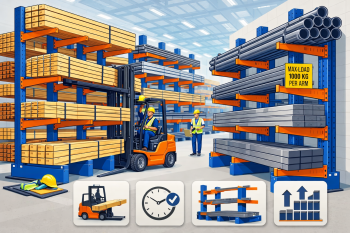
Cantilever racking consists of vertical columns fixed to the floor with horizontal arms extending outwards to support loads. With no front uprights, materials can be loaded and removed along their full length, reducing handling time and the risk of impact damage.
Arm levels can be adjusted to suit different material sizes, making the system suitable for operations where stock dimensions change regularly. Cantilever racking can also be configured as single sided systems placed against walls or double sided systems used in central aisles.
Operational Benefits for Warehouses
One of the main advantages of cantilever racking is ease of access. Clear loading areas allow forklifts and side loaders to handle materials more safely and efficiently.
Key operational benefits include:
-
Safer storage for long and heavy materials
-
Faster loading and picking times
-
Improved stock visibility
-
Flexible layouts that adapt to changing stock profiles
-
Reduced floor stacking and manual handling risks
These benefits help warehouses maintain productivity while improving overall site safety.
Is Cantilever Racking Right for Your Warehouse?
Cantilever racking is particularly well suited to warehouses where long materials form a core part of daily operations. It is commonly used in manufacturing facilities, timber yards, builders’ merchants, and metal stockholding environments.
It may not be suitable for high volume palletised goods, but where long or awkward items are involved, correctly specified industrial cantilever racks often provide a far more effective storage solution.
Assessing suitability requires consideration of load weights, material lengths, handling equipment, and available floor and roof height.
Making Better Use of Available Space
Long materials stored on the floor take up valuable space and can quickly lead to cluttered, unsafe working areas. Cantilever racking allows these items to be stored vertically and in an organised manner, freeing up floor space for vehicle movement and operations.
Using building height effectively also helps warehouses increase storage capacity without expanding their footprint, which can deliver significant cost savings over time.
Design and Safety Considerations
Cantilever racking must be designed correctly to perform safely under load. Arm capacity, column spacing, base fixing, and floor condition all play a critical role in system performance.
Load signage and clear operating guidelines are also important to ensure racking is used as intended. Regular inspections help identify damage early and maintain safe working conditions, particularly in busy handling environments.
Properly designed industrial cantilever racks provide long term reliability and support safer material handling.
Final Thoughts
Cantilever racking is a proven solution for warehouses handling long and heavy materials. When correctly designed and installed, it improves access, increases usable space, and supports efficient, safe operations.
For warehouses where pallets are not practical, cantilever racking offers a reliable and adaptable storage solution that supports both current needs and future growth.