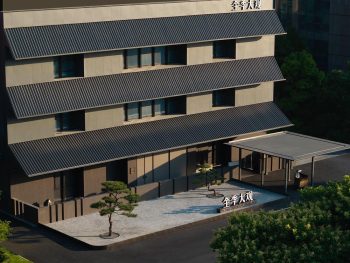
In Ningbo, China, Vermilion Zhou Design Group introduces the Hi Inn Self-Service hotel, a project redefining the economy hotel model for a new generation of travellers. Moving beyond affordability alone, the concept integrates self-service systems, modular construction, and sustainable material strategies to provide both comfort and efficiency. The firm’s design approach carefully balances spatial logic with operational innovation, positioning Hi Inn as a forward-thinking hospitality solution.
Brand Re-Evolution

The brand has evolved from its core principles of lightweight and simple design toward a fully self-service, eco-friendly model. For price-sensitive travellers, Hi Inn Self-Service guarantees reliability while offering safe and affordable accommodation. The design focuses on the real needs of today’s travellers, providing reassurance through both functionality and visual clarity.
Design Language of Self-Service

Here, self-service becomes spatial logic. Colour, materials, and lighting are orchestrated to create a restrained yet welcoming environment where guests can navigate their stay independently. Compact public zones feature dedicated areas for check-in, dining, and laundry, all designed for intuitive guest interaction without staff assistance.
Modular and Unit-Based Design

The project introduces a unitized spatial system, breaking spaces into flexible modules such as wash walls, wardrobe walls, and media walls. Guestrooms are built from prefabricated units that integrate lighting and utilities, enabling quick assembly and efficient operations. This modular approach reduces construction time while ensuring adaptability for future updates or expansions.
Sustainable Practices

Sustainability is embedded in the project, with more than 80% of materials recyclable, including steel panels and standardized hardware. This makes dismantling and reuse feasible, transforming eco-conscious ideals into long-term strategies. By combining efficient design and responsible material use, the project contributes to reducing resource consumption in the hospitality sector.
With Hi Inn Self-Service, Vermilion Zhou Design Group reconstructs the guest journey for the economy hotel sector, offering a balance of affordability, independence, and eco-conscious living. The project demonstrates how systemic design thinking can redefine the industry’s approach to value hospitality.
Technical Sheet
| Role | Name |
|---|---|
| Creative Director | Kuang Ming (Ray) Chou |
| Concept Design | Ting Ho |
| Interior Design | Garvin Hung, Jim Wang, Li Wu, Maochun Cao |
| Lighting Design | Vera Chu |
| FF&E Design | Mengjia Deng |