UNStudio has completed the Korean Football Park in Cheonan, South Korea, creating a new national destination dedicated to the growth of football and community engagement. Designed as the new headquarters of the Korean Football Association (KFA), the project goes beyond the traditional sports complex by combining professional training infrastructure with public amenities, cultural facilities, and civic spaces. Through a carefully planned arrangement of buildings and landscapes, UNStudio has created a campus that supports elite athletes while welcoming visitors into the world of Korean football.
Located south of Seoul, the development brings together multiple sporting, educational, and recreational functions across a unified site. Rather than isolating professional facilities from the public, the project introduces a layered experience where fans, players, administrators, and local residents can coexist within the same environment.
A Campus Designed Around Football Culture
At the heart of the Korean Football Park is a masterplan organized around a clear progression from public to private spaces. Visitors first arrive at a welcoming civic square that connects directly to a museum, fan shop, and public gathering areas. This approach transforms the complex into more than a sports venue, positioning it as a year-round destination for football enthusiasts.
The design reflects an urban planning strategy often seen in successful sports districts, where public engagement becomes part of the overall experience. Instead of functioning solely on match days, the campus remains active through educational programs, exhibitions, tourism, and community events.
Two Stadiums With Distinct Architectural Identities
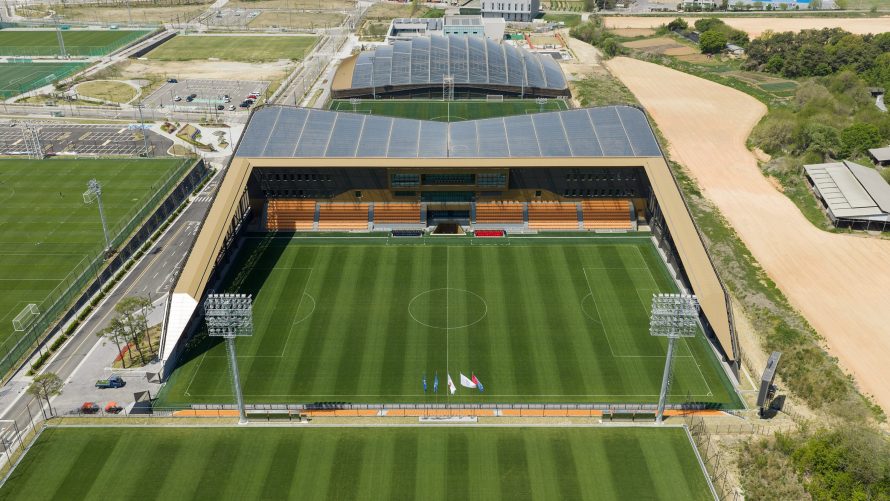
The project features two dedicated stadiums that serve different purposes while sharing a cohesive architectural language. The 1,500-seat outdoor stadium is wrapped in elegant aluminium louvers and anchored by a steel canopy that provides shelter while creating a recognizable visual identity. The structure opens toward the athletes’ accommodation, strengthening connections between training, competition, and daily life.
Behind it stands the indoor stadium, distinguished by its dramatic arched glass roof. The transparent structure introduces abundant natural light while creating a spacious environment for year-round sporting activities. Together, the two venues provide flexible facilities capable of supporting national teams, youth development programs, and special events.
Supporting Elite Performance and Development
Beyond the stadiums, the Korean Football Park includes an extensive collection of facilities designed to support every aspect of football development. The campus contains 11 football fields, healthcare and rehabilitation facilities, accommodation for youth athletes, dedicated women’s training spaces, and hospitality services.
This integrated approach reflects the evolving needs of modern football organizations, where performance is increasingly supported by sports science, education, wellness, and residential programs. By consolidating these functions into a single location, the Korean Football Association gains a centralized environment for nurturing talent and advancing the sport nationwide.
Sustainability and Long-Term Flexibility
Sustainability played a significant role in the design strategy. Both stadiums were conceived with future adaptability in mind, incorporating principles of deconstruction that allow components to be reused or recycled over time. This forward-thinking approach responds to growing demands for environmentally responsible sports infrastructure.
The project also integrates on-site rainwater collection systems, helping reduce water consumption while supporting landscape maintenance. Roads and circulation networks are carefully woven through the site to connect buildings efficiently while preserving clear movement patterns for visitors and athletes.
With its blend of professional facilities, public attractions, and sustainable planning, the Korean Football Park establishes a new benchmark for sports architecture in Asia. By bringing together training, administration, culture, and community engagement, UNStudio has created a football destination that strengthens the relationship between the sport and the public. As the new home of the Korean Football Association, the project demonstrates how contemporary sports architecture can function as both a performance hub and a civic landmark.
| Technical Sheet | |
|---|---|
| Project Name | Korean Football Park |
| Location | Cheonan, South Korea |
| Architect | UNStudio |
| Client | Korean Football Association (KFA) |
| Program | Sports Campus, Football Training Centre, Stadium Complex |
| Main Facilities | 2 Stadiums, 11 Football Fields, Museum, Fan Shop, Hotel, Healthcare Facilities |
| Outdoor Stadium Capacity | 1,500 Seats |
| Sustainability Features | Rainwater Collection, Design for Deconstruction |
| Project Status | Completed |
| Photography | Rohspace |
| Google Maps | View Location |