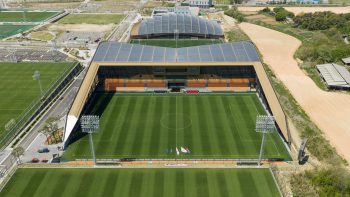
The National Athletics Center in Budapest isn’t just a venue built for a one-off international event—it’s a piece of evolving city fabric. Designed by Hungarian studio NAPUR Architect, the stadium emerged as part of a larger vision to regenerate the city’s southern Danube bank. What sets this project apart is not its scale or prestige, but how it balances athletic spectacle with long-term civic use.
NAPUR Architect: A Generational Practice with Cultural Intent

Founded in 1992, NAPUR Architect is a Budapest-based firm led by architect Marcel Ferencz, DLA, and rooted in multigenerational experience. Known for landmark projects like the Duna Arena and the new Museum of Ethnography, the firm often navigates the intersection of architecture and national identity. For the National Athletics Center, NAPUR tackled more than a stadium—they approached a city-making opportunity.
Their proposal, which won the national design competition, carries classical and symbolic references. A stadium as crown isn’t subtle metaphor, but the designers handled it with restraint. Rather than literal ornament, the reference unfolds in the pure white geometry and taut precision of the structure, elevating athletics as a civic ritual.
Architecture as Urban Infrastructure

Located on the former Vituki industrial estate in Ferencváros, the stadium sits at the heart of a major urban reconfiguration. The 20-hectare site was transformed from brownfield to public realm, connected by a planned pedestrian and bicycle bridge linking North Csepel. But the arena doesn’t dominate the landscape—it works with it.
After hosting the 2023 World Athletics Championships, the temporary upper stands (accommodating 25,000 seats) were dismantled. This move isn’t just practical reuse—the elements were sent to the 2024 Paris Olympics—but signals a shift in architectural purpose: what remains is a 15,000-seat stadium wrapped in open-access parkland.
The Open Arena: A Second Life for a Major Venue

This reconfiguration birthed what’s now known as the Open Arena, a hybrid of stadium and urban park. Where the upper seating once stood, NAPUR introduced the “Open City Ring”—a 15,000 m˛ area with running tracks, a street workout zone, training spaces, and even street food options.
It’s a move that challenges the traditional lifecycle of sports architecture. Rather than becoming underused post-event, the stadium opens up to everyday users. Importantly, it blurs the threshold between inside and outside—architecture is no longer a container for spectacle alone but a framework for daily activity.
Built to Tread Lightly

Sustainability here isn’t greenwashed; it’s embedded in function. Only 10% of the stadium is heated, all powered by geothermal energy. Most of the building is open-air by design, reducing operational demands. A lightweight cable-supported roof spans above, forming a structural ring that defines rather than encloses space. It’s not just minimal, it’s precise—performing only what’s needed.
This approach extends beyond the building. New flood protection, boat stations, bike lanes, and walkways now thread through the area, integrating the project into the wider ecological network of the city. The result: a stadium that doesn’t pull focus but instead lends it—to its surroundings, to the people using it, and to the sport it celebrates.
Technical Sheet
| Item | Details |
|---|---|
| Project Name | National Athletics Center, Budapest |
| Location | Budapest, Hungary |
| Architect | NAPUR Architect Ltd. |
| Chief Architect | Marcel Ferencz, DLA |
| Client | Hungarian State – ÉKM |
| General Contractor | ZÁÉV Zrt. – Magyar Épít? Zrt. Consortium |
| Total Investment Area | 118,000 m˛ |
| Built-in Area | 39,171 m˛ |
| Green Area | 32,198 m˛ |
| Gross Floor Area | 75,213 m˛ |
| Competition Mode Capacity | 40,000 people |
| Basic Mode Capacity | 15,000 people |
| Energy System | 100% renewable geothermal (heated area approx. 10% of total) |
| Open City Ring Area | 15,000 m˛ |
| Year Completed | 2024 (final configuration) |
| Awards | 13th Architizer A+ Awards, Public Choice in Stadium and Sustainable Sports Building categories |