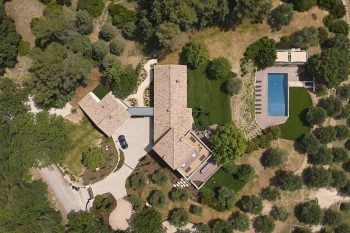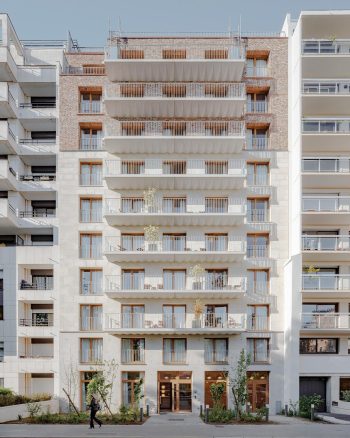
Zaha Hadid Architects has revealed Nest and Cascades, a new residential and hospitality development planned for Kodra e Diellit in Tirana, Albania. Designed for a district known for villas, townhouses, valley views, and proximity to Dajti Mountain, the project introduces a more compact model of urban living while keeping the landscape in focus. The scheme combines apartments, hotel rooms, courtyards, terraces, shaded communal areas, and environmental systems within two related developments that respond to Tirana’s changing residential demand. Zaha Hadid Architects positions the project as an alternative to large family homes, serving younger families, couples, professionals, and retirees seeking smaller but well-connected homes.
A Residential District Shaped by Changing Lifestyles
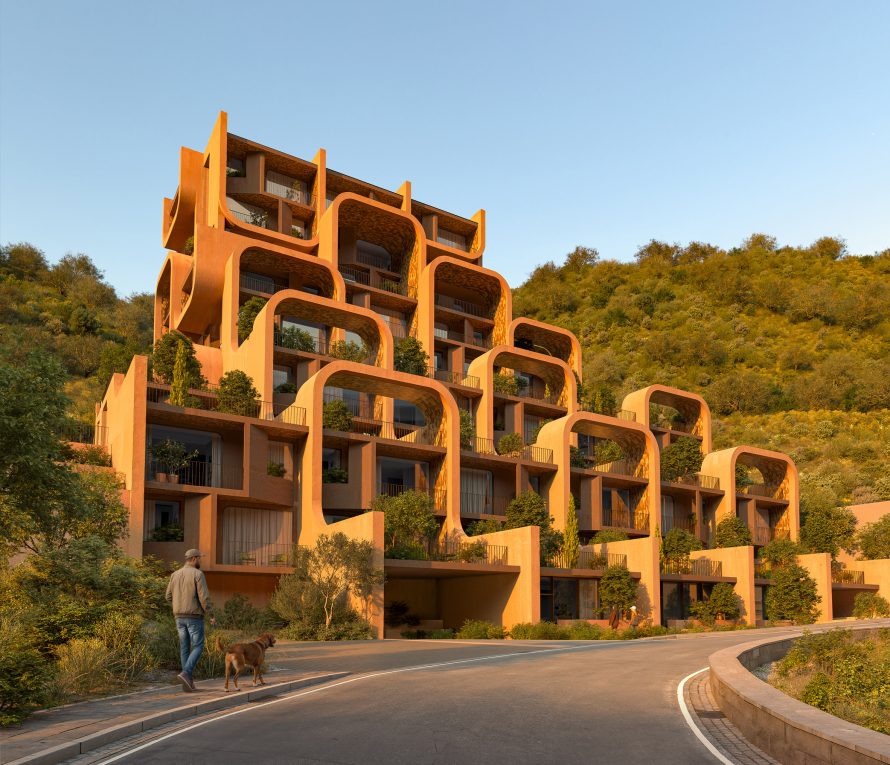
The Nest is the larger part of the scheme, organized as four buildings across four plots. It will include a mix of one-, two-, and three-bedroom apartments, creating a more flexible residential offer for Kodra e Diellit. Instead of treating housing as a series of flat facades stacked toward the sky, the design uses recessed terraces and projecting balconies to create depth, shade, and visual movement.
The surrounding district has traditionally been associated with larger houses, but Tirana’s growth has created demand for a broader range of living options. The Nest responds with apartment layouts intended to support different household types while maintaining a strong connection to outdoor space. The balconies are not just decorative gestures; they are designed as part of the building’s climate response, giving each unit access to fresh air, shade, and views.
Balconies as Passive Climate Infrastructure
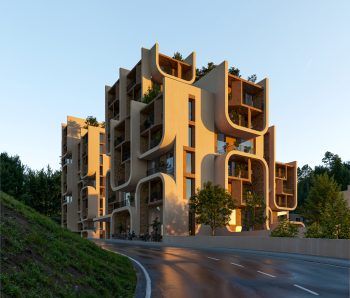
The development reflects the studio’s long-running interest in fluid forms and digitally modeled envelopes. At The Nest, the curved terraces and cantilevered balconies are shaped to work with Tirana’s humid subtropical Mediterranean climate. Deep facade reveals and recessed openings help reduce summer heat gain while allowing lower winter sun to reach deeper into the apartments. The result is a housing block that uses its own geometry as a passive environmental system.
Cross-ventilation is another key part of the design strategy. By shaping the apartment blocks through complex digital models, Zaha Hadid Architects aims to create homes that can breathe more naturally, reducing dependence on mechanical cooling where possible. This matters in a city where rapid development can easily produce sealed, overheated buildings pretending that glass alone is a lifestyle. Here, the facade is expected to do actual work.
Material Colors Drawn from Tirana’s Landscape
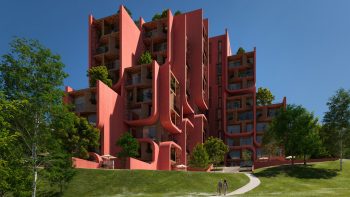
The Nest will be built with modular components and finished in clay-based cladding. Two of the buildings will use fawn-colored surfaces, while the others will feature terracotta and deep red tones. These colors reference the iron-rich soil of the adjacent hillside, giving the development a material identity connected to its location rather than a generic global apartment-block costume.
The central park will add native planting, shaded areas, permeable paving, and high-albedo surfaces to help reduce urban heat island effects. A rainwater harvesting system and rooftop solar array are also planned, turning the landscape into both a social space and a piece of climate infrastructure. The park is intended to link the residential blocks while offering outdoor areas for residents to gather, rest, and move through the site.
The Cascades Extends an Existing Hotel
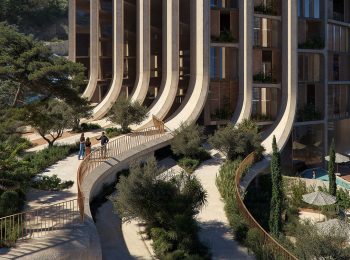
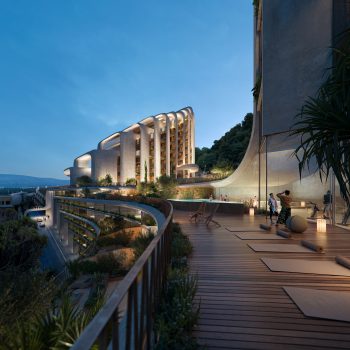
Close to The Nest, The Cascades will expand the existing Arka Art Hotel. The extension will introduce a new 120-room hotel wing and a residential wing, alongside a 60-meter extension to the hotel’s swimming pool. Two landscaped courtyards and a series of cascading garden terraces will provide outdoor meeting areas for hotel guests and residents while framing views toward the valley.
The Cascades will use deep terraces, green roofs, external solar shading, and a rainwater collection system. Its facade will be clad in glassfibre-reinforced concrete panels, cast on site in modular strips and finished in tones intended to evoke local stone. By minimizing structural loads and reducing transport distances, the system supports a more efficient construction process while allowing the building to echo the textures of the surrounding geology.
Together, Nest and Cascades suggest a more layered model of living for Tirana, combining apartments, hospitality, gardens, shaded terraces, renewable energy, and water management. For a rapidly developing capital, the project offers a residential language that is visually expressive without ignoring climate, topography, and daily life. With Nest and Cascades, Zaha Hadid Architects brings its sculptural approach to Kodra e Diellit while grounding the design in the colors, slopes, and environmental conditions of Tirana.
| Technical Sheet | |
|---|---|
| Project Name | Nest and Cascades |
| Architect | Zaha Hadid Architects |
| Location | Kodra e Diellit, Tirana, Albania |
| Project Type | Residential and hospitality development |
| Main Components | The Nest residential blocks, The Cascades hotel and residential extension |
| The Nest Program | Four residential buildings with one-, two-, and three-bedroom apartments |
| The Cascades Program | 120-room hotel wing, residential wing, courtyards, garden terraces, and pool extension |
| Key Design Features | Overhanging balconies, recessed terraces, deep facade reveals, cascading garden terraces |
| Environmental Features | Cross-ventilation, solar shading, rainwater harvesting, rooftop solar array, green roofs, native planting |
| Facade Materials | Clay-based cladding for The Nest; GRC panels for The Cascades |
| Visuals | Engram and Nightnurse |