Autodesk's support for the University of Florida offers a useful starting point for discussing construction robotics. Its August 4, 2026 announcement described a research and training program for industrialized construction. The interesting question is what students and researchers can test before a machine reaches a jobsite, rather than whether a laboratory opening proves that housing will become cheaper.
Move assembly into a testable workflow
The program focuses on off-site and modular building, where digital tools can be studied alongside physical assembly. Autodesk describes collaborative robots handling repetitive wall-framing and panel-assembly work. That is a narrower proposition than automating an entire building project, with its changing site conditions, approvals and many different trades.
A repeatable operation can be a useful research subject without becoming a universal construction method. The next questions concern the assembly sequence, the materials being handled and how the team identifies an error. Those are practical evaluation questions, not measured capabilities established for every robot or factory by this announcement.
Keep digital information connected to the work
The release describes research combining digital twins, BIM and computer vision. One student project uses twins modeled in Autodesk Fusion to help a robot interpret a construction design for assembly. The company explicitly calls this early-stage work. It does not provide a commercial product specification or demonstrate that an arbitrary building model can be fabricated automatically.
That boundary relates to context and approval in connected AEC workflows. Moving information between tools is only part of the task; a person still needs to understand what the information means for the operation being performed. Human judgment remains important when assessing a design decision, an assembly result or a proposed change.
Training is part of the technology
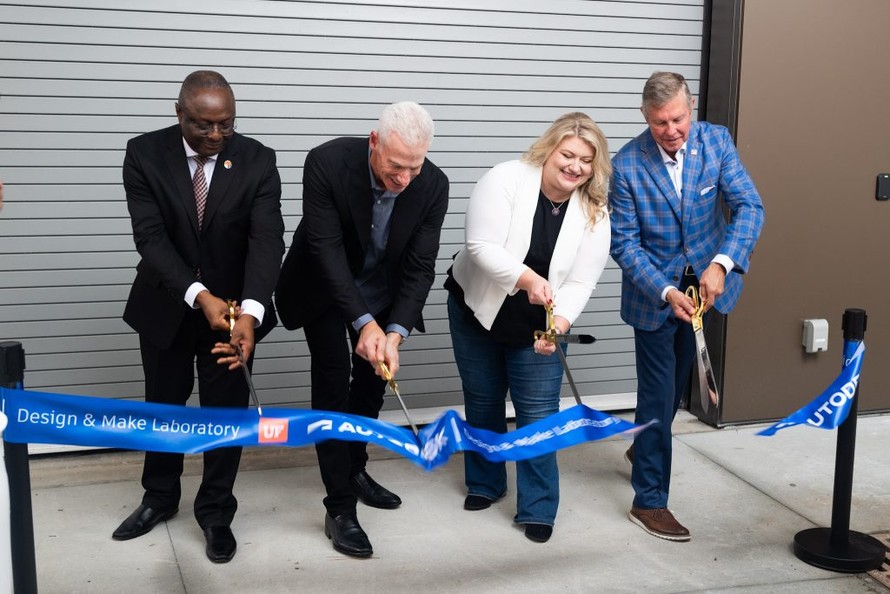
Autodesk announced a $1 million unrestricted donation for equipment, renovations and technical support. The laboratory becomes home to Aladdin Alwisy's Smart Industrialized Design and Construction Lab, spanning construction and engineering disciplines. The relevant takeaway for practice is the opportunity to study building knowledge and digital techniques together, rather than treat robotics as a separate technical specialty.
The announcement also describes the industrialized construction degree program's first cohort arriving that fall. For students, hands-on testing gives a concrete setting for examining how a design becomes an assembly operation. It should also make room for failures and revisions; a successful demonstration alone does not establish a dependable production workflow.
Separate an ambition from a result
The release connects the program with housing and workforce pressures, but supplies no independently verified cost or productivity benchmark for deployment. It discusses promising early tests and expects movement toward real-world use over several years. Those statements describe a research direction, not a guaranteed construction schedule or a replacement for skilled workers.
For architects and construction teams, the useful lesson in Autodesk's account is testing before deployment. Digital fluency, assembly knowledge and review need to develop together. A project considering robotics should ask for evidence tied to its own operation, while keeping the laboratory's exploratory role distinct from commercially demonstrated performance.