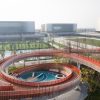
On Huanglong Island in the Zhoushan Archipelago, Lost Villa · Huanglong Island Lighthouse Hotel translates reefs, wind, and village paths into a contemporary island tourism hub. Conceived by WJ STUDIO, the project embraces distance and slowness as design material—suspending new volumes above weathered rock, choreographing movement from harbor to lighthouse, and letting mist, tides, and sun become active collaborators in space. The result is architecture that reads the coast like a palimpsest, where nature, settlement, and travelers inscribe fresh lines without erasing the old.
Nature as Timekeeper

The site occupies an eastern promontory with nearly 30 meters of relief, a living section cut through reef topography and sea grasses. Instead of flattening the terrain, the hotel perches on isolated footings to keep rock outcrops intact, creating a protected “underbelly” where the meeting of smooth soffit and jagged stone forms a gray, wind-cooled threshold. Here, fog season writes its own atmospheres, and architecture frames the long arc of natural time—tides, seasonal light, and the daily swing of horizon lines—so guests feel the island changing hour by hour.
Stitching History into Movement

Huanglong’s terraced stone village—streets, steps, and house plots—provided the pattern for circulation. The design keeps that logic but clarifies it: a curated walking route threads from Southern Port through communal pockets and up the northeastern cliffs, aligning pauses with views and memories. Roads are not merely service lines; they are a narrative device that binds three hotel clusters to existing dwellings, preserving continuity between past and future. Materially and spatially, the project foregrounds what was already there, letting new paths read as careful edits rather than overwrites.
Human-Scale Rooms, Island-Scale Views

Block A opens as a rock hall—reef preserved below, sky admitted above—blurring interior and exterior with calibrated light. In Block B, guest rooms echo the small footprints of village houses yet orchestrate larger horizons through orientation and glazing. Windows catch winter and summer sun differently, composing framed views that invite stillness: breeze through a reveal, wave-sound rising in a quiet band. Within compact plans the project privileges human scale, turning transitions—door to deck, bench to sill—into sensory devices that slow time and heighten attention.
From Depopulation to Destination

The island’s challenge—aging demographics and outmigration—shapes the brief. Rather than insert spectacle, the hotel amplifies everyday coastal life: fishing rhythms, village gatherings, long walks. By seeding public-facing paths and outlooks, the architecture supports rural revitalization and place-based hospitality, where ecological stewardship and craft labor are visible values. In this register, tourism is not extraction but a framework for care, strengthening local identity while drawing new residents and skills. The work closes the loop between visitor experience and ecological tourism, a stance consistently argued and refined by WJ STUDIO.
Technical Sheet
| Project | Lost Villa · Huanglong Island Lighthouse Hotel |
| Location | Huanglong Island, Shengsi County, Zhoushan, Zhejiang, China |
| Completion Year | 2025 |
| Type | Hotel |
| Building Area | 5,000 m² |
| Client | Zhoushan Shengsi Lost Villa Hotel Management Co., Ltd. |
| Master Planning & Architectural Design & Interior Concept | WJ STUDIO |
| Principal Designer | Hu Zhile |
| Design Team | Jin Yiran, Yang Xi, Liu Yuao, Huang Shufei |
| Structural Design | Peng Zhu |
| Water Supply & Drainage | Wu Xu |
| Electrical Design | Fang Weigang |
| Heating & Ventilation | Zhou Jie |
| Conceptual Planning | Urban Fabric |
| Interior Design | SZ-Architects |
| Construction | Shanghai Yeyouzhu Decoration Engineering Co., Ltd. |
| Photography | Tian Fangfang, Zhang Xi |
| Video | Zhang Xi, STUDIO FANG (shooting); Zhang Xi (editing) |
| Architect Website | WJ STUDIO — see link in introduction |