Las Vegas might be known for its spectacle, but a quieter kind of transformation is taking place in the city’s Arts District. Los Angeles-based firm Aaron Neubert Architects (ANX) has revealed its latest project: a mixed-use development that subtly challenges the norms of density, scale, and public engagement in the city’s urban core. With a layered approach to form and a clear intention to activate the street experience, the design hints at a future for Las Vegas that’s more connected, livable, and human-centered.
A Balancing Act Between Vertical and Horizontal
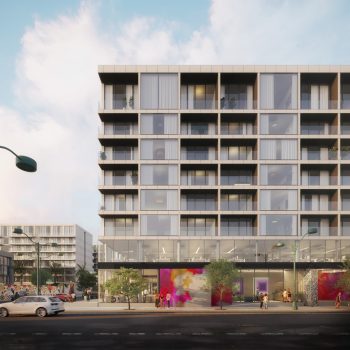
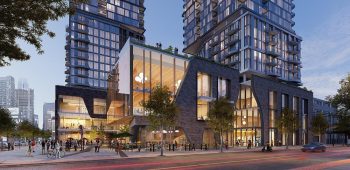
Set within the heart of the Arts District, the building takes on a mid-rise profile that navigates a careful balance: verticality that asserts presence and horizontality that welcomes. ANX’s form-making is driven not by spectacle but by rhythm—volumes that shift, setbacks that reveal, and voids that breathe. The massing reflects a sensitivity to solar orientation and view corridors, resulting in a building that doesn’t impose but rather negotiates its place in the skyline.
It’s a study in urban calibration, where the built form adjusts to its site, rather than vice versa. This approach also allows for daylight to permeate shared areas and creates visual openings that help the block feel less monolithic, more permeable.
Street-Level as Stage

One of the project’s defining moves is its engagement with the street. Instead of a closed-off edge, the base opens up through shaded arcades, storefront glazing, and inviting public plazas. This permeability is intentional: by encouraging a dynamic pedestrian experience, the building integrates into the neighborhood’s street life rather than standing apart from it.
Retail spaces, health and wellness programs, and other amenities are woven into the ground level, while the residential units above are supported by generous terraces and shared decks. These aren’t just functional gestures—they’re meant to cultivate social overlap, providing casual gathering points that elevate the experience of urban living.
Materiality with Restraint

The architectural language leans on restraint rather than exuberance. A curated palette of materials grounds the building: high-performance glazing systems modulate light and heat, while matte-finish metal panels and warm-toned wood accents add a tactile quality to the facade. Vertical fins and slab extensions offer visual texture and depth, breaking up the mass into human-readable segments.
The base is defined by masonry and concrete in warm, tactile finishes, creating a comfortable transition from public to private realms. Color shifts—silver-gray, desert taupe, and bronze—mirror the desert light and lend a quiet dynamism as the day unfolds.
Programmed for Mixed Experience

Functionally, the building operates across several urban programs: housing, retail, wellness, and lifestyle. The architecture isn’t designed around a single use but instead sets up a framework for overlap—residents above, pedestrians below, community throughout. Circulation spaces aren’t hidden but celebrated, turning corridors and decks into opportunities for casual interaction.
In this way, the building becomes more than a container—it becomes a site for activity, a structure that doesn’t just occupy space, but contributes to it.
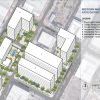


Technical Sheet
| Project Name | Midtown, Arts District |
|---|---|
| Location | Las Vegas, Nevada |
| Architect | ANX / Aaron Neubert Architects |
| Developer | Z Life |
| Structural Engineers | Keegan Engineering, RJC Engineers |
| MEP Engineer | Engin 8 |
| Civil Engineer | Reitz Consulting, Inc. |
| Fire/Life Safety | ACS Group |
| Interior Design | Studio Collective |
| General Contractor | Trident Construction Corporation |