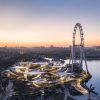
The new Museum of Ethnography in Budapest, designed by NAPUR Architect Ltd. under lead architect Marcel Ferencz, is a key addition to the Liget Budapest Project. Instead of acting as a standalone object, the building behaves like a piece of landscape, bridging City Park (Varosliget) and the surrounding urban fabric through a pair of gently curving wings.
After operating for generations without a purpose-built home, the institution now occupies a contemporary facility shaped around museum needs, from collection care to visitor movement. For a collection of around 250,000 items, the new building is not just a relocation, but a long-overdue upgrade in spatial capacity and curatorial flexibility.
A Museum That Becomes Landscape

The architecture prioritizes park continuity: about 60% of the building sits below ground, allowing the roof to become accessible green terrain rather than a conventional cap. Visitors can experience the building as a public garden and terrace, turning the museum into civic infrastructure that supports everyday use, not only exhibitions.
The curving form works as a gateway and passage, making the museum legible from the city while remaining scaled to the park. Its lines are calm and minimal from afar, but spatially ambitious in section, where underground volume supports large interior programs without dominating the landscape above.
The Pixel Facade as Cultural Code

The museum’s most recognizable feature is the glass curtain wall wrapped by a metal grid of nearly half a million pixels. These small elements translate ethnographic motifs into a contemporary raster, forming a facade that functions as both shading system and cultural signal.
The pixelated field was assembled using laser-cut aluminum grids and robot-assisted insertion, with more than 2,000 units attached to the building. Motifs include 20 Hungarian and 20 international contemporary reinterpretations, turning the building skin into a data-like tapestry tied directly to the museum’s collections.
Bridge Engineering Inside a Public Building

Beneath the roof garden, the building uses an unusual structural approach for a cultural institution: the arched wings are supported by a post-tensioned structure more commonly seen in bridge construction. This strategy enables wide spans and open interiors, supporting flexible exhibition planning and visitor flow.
The structure and envelope work together to support modern museum demands, from controlled lighting to adaptable gallery layouts. Sustainability is embedded through the building’s section logic, landscape integration, and the facade’s environmental performance, rather than being treated as a separate design layer.
A New Cultural Anchor in Budapest

The project drew major international attention early on, including recognition at MIPIM Awards (2017) and the International Property Awards (2018). Beyond awards, the building’s value lies in how it reframes a museum as a public landscape, hosting social life on its roof while protecting and presenting material culture below.
For Marcel Ferencz and NAPUR Architect Ltd., the Museum of Ethnography strengthens their position in contemporary European cultural architecture, combining strong identity, technical innovation, and a careful relationship with Varosliget and the wider city.
Technical Sheet
| Project Name | The New Museum of Ethnography |
| Location | Budapest, Hungary (Varosliget – City Park) |
| Architecture Design | Marcel Ferencz – NAPUR Architect Ltd. |
| Client | Varosliget Ltd. |
| Building Owner | Museum of Ethnography |
| Built Area | 33,000 m2 |
| Site Area | 100,000 m2 |
| Design Year | 2016-2018 |
| Completion Year | 2022 |
| Typology | Cultural – Museum |
| Status | Built |