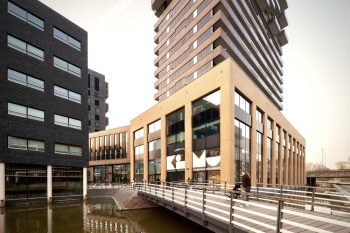
KiMu Children’s Art Museum has opened in Amsterdam Noord as a new cultural place where children are treated not as passive visitors, but as autonomous makers. Developed spatially with WE architecten, the museum transforms an empty concrete shell into a warm, open and process-driven environment for art, imagination and independent making.
Located across the River IJ in one of Amsterdam’s most active cultural districts, KiMu Kinderkunstmuseum gives children room to explore materials, test ideas, fail, rebuild and follow their own creative path. Instead of pushing toward a polished result, the museum builds its identity around creative process and child autonomy, two ideas that shape both its educational method and interior design.
A Museum Built Around Process
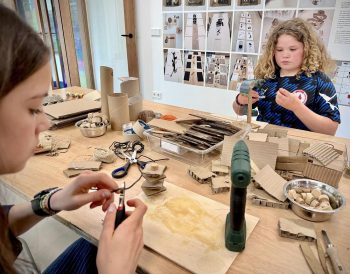
KiMu opens with Parallel Processes, an exhibition that places the work of nearly seventy children alongside that of Dutch artists Brian Elstak, Willem Harbers and Roos van Haaften. The project is not arranged as a simple comparison between young makers and professionals. Instead, it reveals how children and artists can develop ideas through similar materials, questions and strategies without directly influencing one another.
The exhibition includes sketches, tests, unfinished attempts and intermediate steps, making the act of making as important as the final artwork. Robots, structures, light experiments and material assemblies appear as traces of thought in motion. The result is a museum experience that quietly argues that children’s creative decisions deserve serious attention, which apparently needed saying because adulthood is a very strange design brief.
Ateliers, Not Classrooms
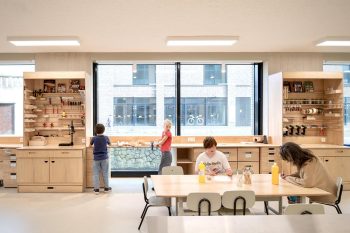
The museum’s ateliers are designed as working spaces rather than instructional rooms. Children are not given fixed assignments, strict themes or predetermined outcomes. Instead, KiMu prepares tables, floors, tools and materials so that children can begin from curiosity and move at their own pace.
This approach is rooted in the pedagogical experience of founder Suzanne Huis, who has worked with children in atelier settings for many years. Her vision guides the museum’s atmosphere: open, trusting and practical. The setup supports independent exploration while still offering enough structure for concentration, care and meaningful creative work.
Turning a Concrete Shell Into a Children’s Museum
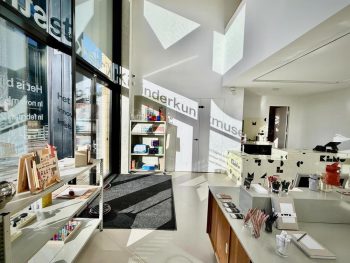
The interior keeps much of the original industrial character of the building visible. Rather than covering the raw concrete base, the design uses it as a calm background for new spatial insertions. A large central double-height space, generous windows facing the water and a two-storey foyer create openness from the moment visitors enter.
Two wooden staircases, a triangular balcony and a suspended net introduce movement, play and new perspectives inside the volume. The balcony works almost like a small lookout point, while the net offers children a place to lounge, pause and observe. A mirror above the net reflects light and the nearby water, adding a subtle layer of discovery to the space.
Material Warmth and Open Sightlines
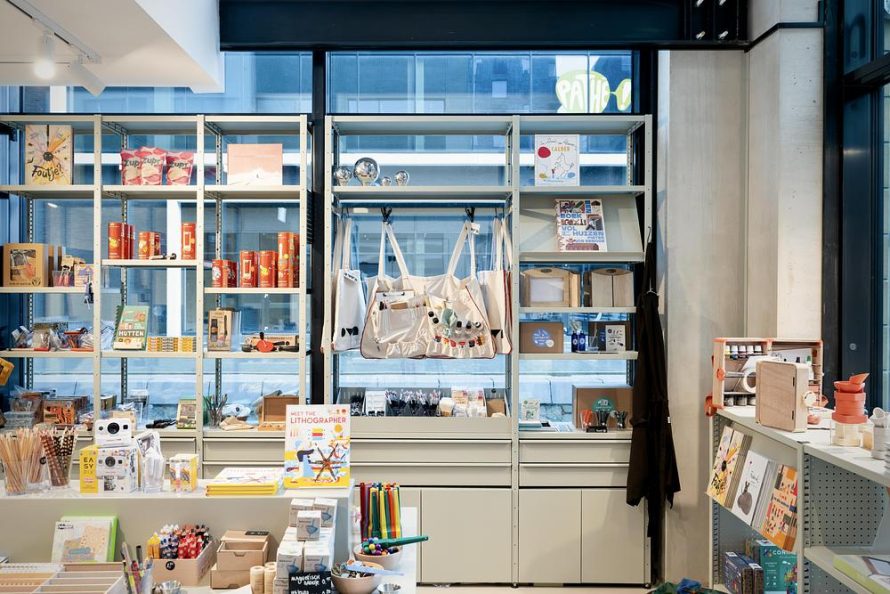
The interior palette balances soft industrial grey with moss yellow accents, cherry wood frames and custom-built elements. Internal windows keep sightlines open between ateliers and public spaces, allowing children, parents and educators to remain visually connected without making the environment feel controlled.
Many interior elements were designed, adapted or built during the process, including furniture made with reused or found materials. Children also contributed to parts of the interior, including printed tiles used on the combined foyer and shop counter. This makes the building itself part of the museum’s learning culture, where process is not hidden behind a perfect finish.
Other contributors add further layers to the museum. Rein created a large light installation in the foyer, Lika Kortmann of Likapika worked on carpentry, i29 architects contributed the locker system under the Elements Amsterdam label, and OneTwoTree built the net structure. Together, these elements support an environment that is playful without becoming chaotic, restrained without becoming sterile.
KiMu shows how a museum for children can be both generous and precise: open enough for imagination, but carefully designed enough to support focus. Through its collaboration with WE architecten, KiMu Kinderkunstmuseum turns a raw Amsterdam Noord interior into a cultural space where children can think, make and develop on their own terms.
| Technical Sheet | |
|---|---|
| Project | KiMu Children’s Art Museum / KiMu Kinderkunstmuseum |
| Location | Termini 487, 1025 XM Amsterdam, Netherlands |
| Client | KiMu Kinderkunstmuseum / Suzanne Huis, founder |
| Architect | WE architecten: Wouter van Alebeek, Erik de Vries and Zofia Sosnierz |
| Interior Design | Suzanne Huis in collaboration with WE architecten |
| Visual Identity, Logo and Signage | HOAX |
| Opening Exhibition | Parallel Processes |
| Artists | The children of KiMu, Brian Elstak, Roos van Haaften and Willem Harbers |
| Ateliers Exhibition Setup | Supplied and arranged by KiMu, with input from Brian Elstak, Willem Harbers and Roos van Haaften |
| Light Studio | Developed in collaboration with Stichting TOEVAL GEZOCHT |
| Light Installation | Rein |
| Carpentry | Lika Kortmann / Likapika |
| Lockers | Elements, designed by Jeroen Dellensen for i29 |
| Net Structure | Design by WE architecten, built by OneTwoTree |
| Vintage Furniture | Strijk Design and Van Dijk & Co, Amsterdam |