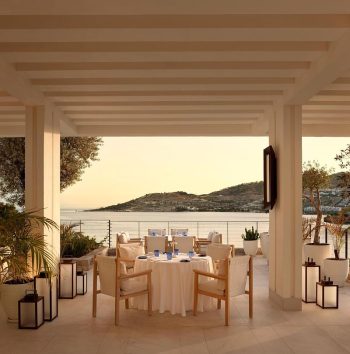
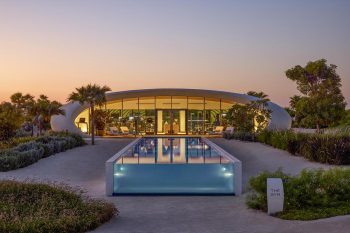
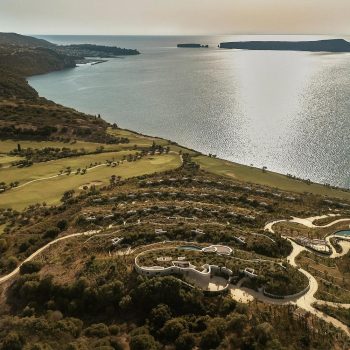
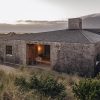
Set on a steep hillside with sweeping views of Souda Bay, the JW Marriott Crete Resort & Spa is Block722’s latest venture into context-driven hospitality design. Opening in June 2025, this project revisits the essence of Mediterranean architecture while syncing seamlessly with the untamed coastline of Akra Pelegrí. The Athens-based studio brings a calm but confident architectural language to this five-star resort, quietly reshaping expectations of luxury by rooting it in place, material, and light.
A Dialogue with Terrain and Tradition

The resort’s foundation—both literally and conceptually—lies in the local topography. With minimal disruption to the landscape, the buildings step down amphitheatrically, echoing the slope of the rocky site. This positioning ensures unobstructed sea views and natural ventilation throughout. Instead of imposing a structure on the land, Block722 worked with it, restoring the original contours where possible and drawing architectural references from the island’s vernacular forms. Clean-lined geometry, Dorian-inspired colonnades, and local stone construction all contribute to a contemporary palette that still feels distinctly Cretan.
Material Honesty and Sensory Subtlety

What sets the JW Marriott Crete apart is not its grandeur, but its groundedness. Stone extracted directly from the site is used in walls and retaining structures, while wood, linen, terracotta, and natural fiber furnishings create a tactile dialogue with the landscape. Even the cement uses aggregates from the surrounding soil. Block722’s approach feels less about building and more about coaxing the architecture out of the earth. Indoors and outdoors are treated as one continuous space: shaded verandas blur into suites, and lobby gardens grow beneath skylights. The result is an experience that’s both spatial and sensory—an unfolding sequence of sea, scent, and texture.
A Resort Without Spectacle

Though large—spanning nearly 60,000 m²—the project avoids spectacle. Instead, it organizes itself around modest gestures: a plaza shaded by native shrubs, a water feature reflecting dappled pergola shadows, and quiet paths linking private and communal zones. From arrival to accommodation, the progression feels carefully choreographed. Facilities like restaurants, pools, and the spa sit low in the landscape, while rooms and suites rise with the terrain. Each guest room is its own discreet volume with private pools and shaded terraces, embracing both retreat and connection.
Sustainability in Practice, Not Performance
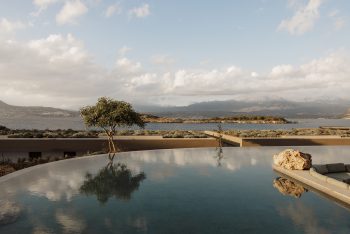
Block722’s sustainability strategy leans on pragmatism rather than show. Green roofs, solar panels, and local planting schemes reduce the environmental load while enriching biodiversity. The buildings are oriented to optimize daylight and breezes, with deep pergolas offering natural shade. Environmental systems—both passive and active—are integrated without calling attention to themselves. In this way, the resort quietly affirms that ecological care can be elegant, and that meaningful luxury might just begin with restraint.


Technical Sheet
| Hotel Name | JW Marriott Crete Resort & Spa |
|---|---|
| Location | Marathi, Crete, Greece |
| Opening Date | June 2025 |
| Status | Completed |
| Site Area | 59,700 m² |
| Built Area | 13,600 m² |
| Number of Rooms | 160 rooms and suites |
| Client | Marriott Hotels & Resorts |
| Owner | Vasilakis S.A. |
| Brand | JW Marriott |
| Operator | SWOT Hospitality |
| Architects | Block722 |
| Lead Architects | Sotiris Tsergas, Katia Margaritoglou |
| Design Team | Christina Kontou, Elena Milidaki, et al. |
| Interior Design | Block722 |
| Landscape Architecture | Doxiadis+ |
| Lighting Design | L+DG Lighting Architects |
| Structural Engineering | PLINTH engineers |
| MEP Engineering | Agapakis & Associates L.P. |
| Spa & Wellness Consultants | Eminence Hospitality, Andrew Gibson |
| Facilities | Restaurants (Fayi, Anoee, Onalos, Cuccagna), Bars, Spa & Wellness Center, Kids Club, Gym, JW Market, Retail |
| Photography | Ana Santl |
| Art Direction | Block722, Efi Spyrou |