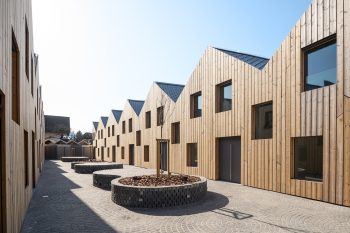
Located in the 19th arrondissement of Paris, the Rue Bouret project introduces 34 social housing units and a neighborhood nursery into a dense and heterogeneous urban fabric. Designed by PietriArchitectes, the building reflects a carefully calibrated response to context, light, and material responsibility, avoiding monumentality in favor of precise urban integration. From the outset, PietriArchitectes positions the project as an everyday piece of the city rather than a standalone architectural statement.
Urban Continuity in a Fragmented Context
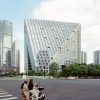
Rue Bouret is defined by architectural contrasts: post-1970s apartment blocks stand beside older townhouses and buildings from multiple eras. Instead of forcing a singular identity, the project seeks continuity. The first four levels align precisely with the existing street frontage, maintaining the established urban rhythm and reinforcing the legibility of the street section.
From the fifth floor upward, the building gradually steps back, forming a pyramidal profile reminiscent of Henri Sauvage’s stepped housing in Paris. This formal strategy limits overshadowing, improves daylight access, and enhances natural ventilation for both the project itself and its surroundings. The resulting massing positions the building as a mediator rather than an interruption within the streetscape.
Wood, Stone, and Constructive Sobriety
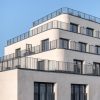
The entire vertical structure is built in wood, significantly reducing the project’s carbon footprint. On the street side, load-bearing stone facades provide a durable and timeless expression that resonates with traditional Parisian architecture while ensuring long-term performance.
Facing the courtyard, a timber frame wall system (MOB) is employed, allowing for prefabrication and faster, quieter installation in a dense urban environment. Concrete use is limited strictly to elements required for structural stability. This balanced material assembly prioritizes low-carbon construction while delivering high thermal performance through constructive restraint rather than technological excess.
Stepped Volumes and Everyday Comfort
Beyond urban considerations, the stepped configuration directly shapes the quality of life inside the building. Apartments benefit from increased sunlight, cross-ventilation, and unobstructed views. Outdoor spaces are not treated as secondary balconies but as genuine extensions of the living areas, embedded into the architectural form.
The inclusion of a nursery on the ground floor reinforces the project’s role as a piece of social infrastructure. By combining housing and local services, the building supports everyday neighborhood life while contributing to the city’s broader objective of increasing affordable housing capacity.
Climate Performance and Long-Term Urban Value

The project complies with the Paris Climate Plan and achieves RT 2012 -20% performance, confirming a commitment to energy efficiency aligned with contemporary environmental targets. Rather than relying on expressive gestures, the project demonstrates how material choice, massing, and urban logic can deliver sustainable performance through architectural fundamentals.
At Rue Bouret, PietriArchitectes once again articulates an approach rooted in pragmatic urbanism and poetic restraint. The project stands as a quietly confident contribution to Parisian housing, where architectural ambition is measured by durability, usability, and respect for the existing city.
| Technical Sheet | |
|---|---|
| Project | 34 social housing units and 1 nursery |
| Location | 27 Rue Bouret, 19th arrondissement, Paris, France |
| Client | Constructa |
| Architect | PietriArchitectes |
| Environmental Standards | Paris Climate Plan / RT 2012 -20% |
| Total Area | 2,081 m² |
| Construction Cost | €5 million |
| Completion | October 2025 |