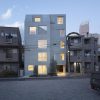
Slot House, designed by ANX / Aaron Neubert Architects, explores how a compact house can turn a steep urban hillside into a layered domestic landscape. Located above the Silver Lake hills and reservoir in Los Angeles, the 2,400-square-foot residence is conceived as a tightly stacked volume that works with the slope rather than resisting it. Instead of flattening the terrain into submission, the project uses topography as an active design tool, producing a home that feels both embedded and open.
What makes the project compelling is not just its dramatic setting, but the way it organizes daily life through a sequence of transitions. The house moves between enclosure and exposure, between carved ground and framed view, creating an experience that is spatially rich despite its relatively modest footprint. This is hillside living treated less as spectacle and more as a careful act of calibration.
Building With the Slope

The architecture begins with a clear response to the site’s difficult geometry. Rather than placing an object on the hill, the design relies on a strategy of carving, retaining, and bridging. The garage is recessed into the hillside, forming a grounded base that supports two levels of living above. This layered arrangement allows the house to sit deeper within the terrain, reducing its visual bulk while strengthening its relationship to the land.
That decision also creates one of the project’s most interesting conditions: a private rear terrace shaped by retaining walls and protected by the surrounding earth. Instead of treating outdoor space as leftover perimeter, the house produces an intimate open-air room that feels excavated from the site itself. The result is a quieter, more inward-facing counterbalance to the street facade.
Circulation as Spatial Experience

A bridge extending from the second floor connects the house directly to the upper portion of the property, turning circulation into a key architectural gesture. More than a practical link, this element helps stitch the residence into the hillside and reinforces the idea that architecture and landscape should be read as one continuous experience. Movement through the house is therefore never detached from the terrain around it.
This sense of connection continues inside, where the layout privileges flow over compartmentalization. Entry, stair, hallway, and shared spaces are aligned in a way that encourages long sightlines and gradual spatial unfolding. The house does not reveal itself all at once. It lets rooms, views, and thresholds emerge in sequence, giving the compact plan a surprising sense of depth.
Light, Views, and Interior Depth

At the center of the residence, a continuous skylight draws daylight deep into the interior. Running along the circulation spine and aligned with views at each end, the skylight acts as both a source of illumination and a visual organizer. It establishes a linear corridor of light that extends from the street-facing porch toward the rear terrace, helping the interior feel longer, brighter, and more connected.
Carefully placed glazing strengthens this effect without sacrificing privacy. Openings frame views of the surrounding mountains and reservoir while limiting direct exposure to neighboring properties. This selective transparency gives the home an expansive atmosphere without relying on total openness. The design understands that on dense hillside sites, the best views often come from precision, not excess glass.
A Compact House With Expansive Ambition
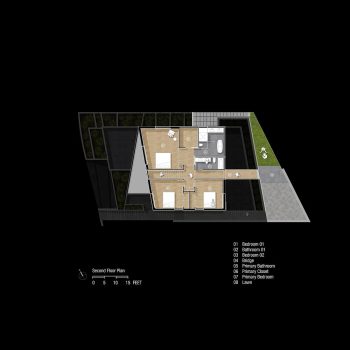
The primary living spaces are arranged as open volumes that support fluid movement and layered visual relationships. From the porch, views continue through the living and dining areas toward the terrace beyond, blurring the distinction between interior and exterior. These spaces feel generous not because they are oversized, but because they are strategically connected to light, air, and landscape.
In the end, Slot House shows how constraints can sharpen architectural thinking. Through a careful balance of openness and refuge, exposure and privacy, ANX / Aaron Neubert Architects turns a steep Silver Lake site into a home defined by sequence, light, and terrain. Rather than imposing itself on the hillside, the project settles into it, making the slope inseparable from the experience of dwelling.
| Technical Sheet | |
|---|---|
| Project Name | Slot House |
| Location | Los Angeles, California, United States (View on Google Maps) |
| Architect | ANX / Aaron Neubert Architects |
| Interiors | ANX / Aaron Neubert Architects |
| Landscape | LPO |
| Structural Engineer | Craig Phillips Engineering |
| MEP Engineer | Hariton Engineering |
| Civil Engineer | TDR Engineering |
| General Contractor | Pak-Sha, Inc. |
| Photographer | Paul Vu/HANA |
| Project Type | Single-family residence |
| Area | 2,400 square feet |