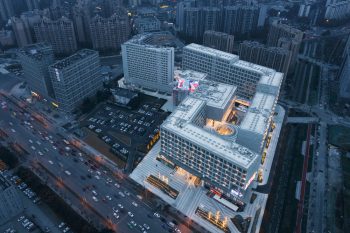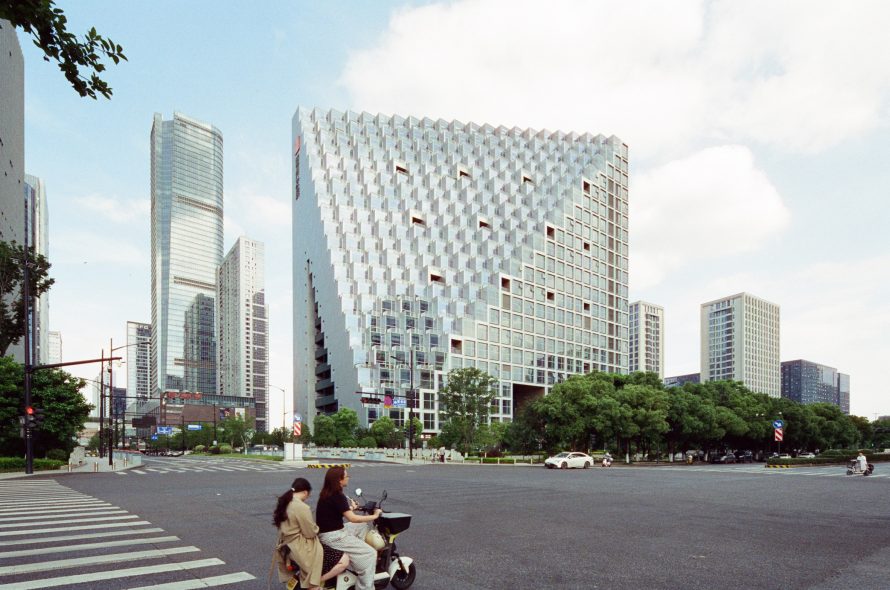
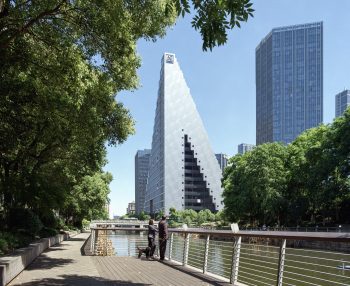
OMA has completed Hangzhou Prism, a pyramidal mixed-use complex in Hangzhou, China, that turns a conventional tower brief into a layered urban landmark. Located in the city’s Future Tech City development, the project brings together hotel, residential, office, commercial, and public space within a sculptural form designed by OMA.
Rather than following the predictable formula of stacked residential blocks, because apparently cities have suffered enough from that habit, Hangzhou Prism proposes a more porous model. Its asymmetric volume creates the image of a three-dimensional village, where private terraces, communal spaces, and a generous public atrium are woven into one recognizable silhouette.
A Landmark Shaped by Oblique Geometry
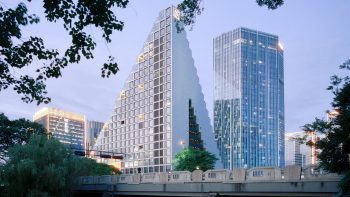
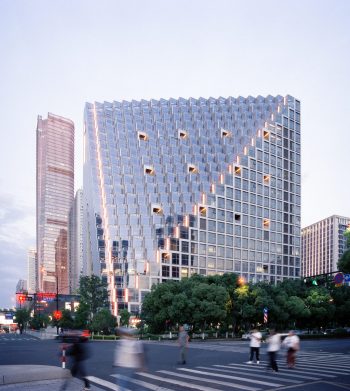
The building rises to 106.5 meters and is defined by two dramatic oblique facades. These angled surfaces give Hangzhou Prism its pyramidal identity, while projecting cubic balconies animate the exterior and create a sense of depth across the facade.
This geometry is not merely visual theater. The sloping form helps organize the program vertically, placing loft-style residences on the upper levels while allowing the lower parts of the building to connect more actively with the surrounding district. The result is a mixed-use architecture that feels less like an isolated object and more like a compact urban terrain.
Hotel, Lofts, Offices, and Retail in One Structure
Inside the 43,000-square-meter complex, the hotel occupies the largest share of the building with approximately 20,000 square meters. Residential lofts cover around 10,000 square meters, while office and commercial areas take up 5,000 and 8,000 square meters respectively.
The lofts are positioned on the upper floors to provide privacy and broad views over Hangzhou. Each unit includes a private outdoor terrace, giving residents access to open air within a dense urban setting. It is a small act of architectural mercy, really, considering how many towers treat balconies like decorative afterthoughts.
A Public Square Inside the Building
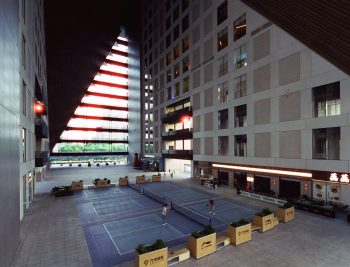
At ground level, Hangzhou Prism opens into a large atrium conceived as a public square. This internal civic space connects to the adjacent park and is intended for events, gatherings, and everyday encounters between residents, hotel guests, office workers, and visitors.
The atrium is lined with balconies and windows, making the public interior visible from multiple levels. This spatial strategy reinforces the project’s social ambition: to create a building where circulation, community, and public life are not hidden in leftover corners but placed at the heart of the design.
Urban Living Beyond the Typical Tower
Hangzhou Prism reflects the changing character of Hangzhou’s Future Tech City, an area shaped by innovation, creative industries, and new patterns of urban living. Its form responds to this context by combining strong visual identity with flexible spaces for work, hospitality, residence, and leisure.
Led by OMA partner Chris van Duijn and project architect Michael Hadjistyllis, the project translates the idea of a landmark into something more layered than a skyline gesture. With Hangzhou Prism, OMA frames density as a social experience, turning a pyramidal building into a compact village for the city’s next urban chapter.
| Technical Sheet | |
|---|---|
| Project Name | Hangzhou Prism |
| Location | Hangzhou Future Tech City, Hangzhou, China |
| Architecture Studio | OMA |
| Partner in Charge | Chris van Duijn |
| Project Architect | Michael Hadjistyllis |
| Building Type | Mixed-use complex |
| Total Area | 43,000 square meters |
| Height | 106.5 meters |
| Program | Hotel, residences, offices, commercial areas, public square |
| Hotel Area | 20,000 square meters |
| Residential Area | 10,000 square meters |
| Office Area | 5,000 square meters |
| Commercial Area | 8,000 square meters |
| Photography | Tu Ximeng; Zhu Wenqiao for atrium photo |