House 720 Degrees in Valle de Bravo, Mexico, is a residential project that treats architecture as both a spatial instrument and an environmental mediator. Designed by Fernanda Canales, the house expands the idea of panoramic living by doubling the traditional 360-degree vision into a continuous spatial loop that shifts between outward views and inward focus. Rooted in geometry, climate, and landscape, the project demonstrates how a circular plan can become a tool for orientation, timekeeping, and daily inhabitation.
Geometry as a Device for Living

At the core of House 720 Degrees is a central patio that acts as both spatial anchor and environmental regulator. During the day, the house opens outward, framing views of mountains and a distant volcano along its circular perimeter. At night, it turns inward, centering domestic life around the courtyard. This dual condition allows the house to operate as a solar clock, registering the passage of time through light, shadow, and movement.
Three Volumes, One Landscape
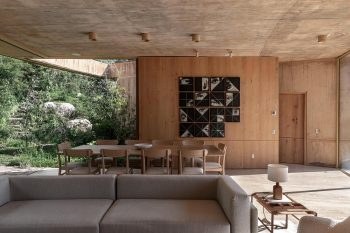
The project is composed of three distinct volumes: the main circular house, a detached studio or guest room, and a rectangular block containing additional bedrooms and services. This separation responds directly to the accentuated topography of the site and helps preserve existing vegetation. Designed to accommodate two families as well as extended relatives and guests, the layout balances privacy and collectivity without relying on conventional hierarchies of space.
Flexible Interiors and Climate Response

Inside the circular volume, rectangular rooms for bedrooms, bathrooms, and the kitchen are nested within curved circulation zones. These curved walls extend outward as terraces toward the courtyard and gardens toward the exterior landscape. Large fold-away windows, privacy screens, and framed openings allow interior spaces to remain adaptable, reinforcing a constant dialogue between inside and outside while addressing extreme climate variation.
Material Continuity and Off-Grid Living

House 720 Degrees is deliberately earthbound, using local soil mixed with concrete to achieve a natural finish that blends into its surroundings. The low-profile design minimizes visual impact while reinforcing permanence. Most furniture and lighting were produced on site using local materials and craftsmanship. The house operates off-grid through rainwater harvesting, solar power generation, and hydronic radiant floors, prioritizing durability and long-term maintenance efficiency.
Through House 720 Degrees, Fernanda Canales demonstrates how architecture can remain precise yet adaptive, quietly evolving with the landscape rather than dominating it.
Technical Sheet
| Project Name | House 720 Degrees |
| Architect | Fernanda Canales |
| Website | Fernanda Canales |
| Location | La Reserva Penitas, State of Mexico, Mexico |
| Completion | 2024 |
| Site Area | 8,000 sqm |
| Built Area | 1,115 sqm |
| Architect of Record | Fernanda Canales |
| Interior Decoration | Camilla Pallares |
| Structural Engineer | Gerson Huerta – Grupo Sai |
| MEP | Carlos Medina – Grupo MEB |
| Lighting | Lucas Salas |
| General Contractor | Felipe Nieto |
| Photography | Rafael Gamo, Camila Cossio |