The Crystal, the new extension to the financial institution Nykredit, by schmidt hammer lassen architects, has won an Emirates Glass LEAF Award in the category ‘Best Structural Design of the Year’ 2011. By this award, the Emirates Glass LEAF Awards recognizes The Crystal as an innovative architectural design setting the benchmark for the international architectural community of the next generation, and amongst the best that global architecture has to offer.
The winners of the Emirates Glass LEAF Awards 2011 were announced at a ceremony in London on 16th September 2011.
The Crystal is sited northwest of the existing Nykredit Headquarters, called the Glass Cube, on the edge of the new waterfront and the historic Copenhagen.
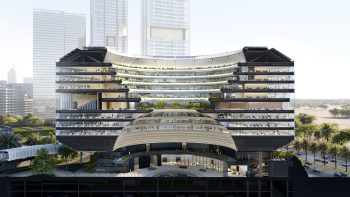
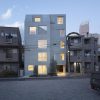
“Freestanding on the site, the building reads as a transparent, geometrical, glazed form which, resting only on a single point and a single line, floats as a visually light, crystalline structure above the plaza,” explained Partner Mr Kim Holst Jensen of schmidt hammer lassen architects. He continued: “The building and the plaza are designed to interact with each other and with the surrounding city.”

In terms of both form and scale, the building is intermediate between the city and the harbour, and harmonises with neighbouring buildings. On the southern side, it rises with reference to the gable apex of the “Elephant House” and creates space for the main entrance. From the corner of Puggardsgade and Hambrosgade, the passage under the building allows a clear view towards Nykredit’s head office building and the harbour.
The interior of the building complies with the demands for functionality, flexibility and efficiency. The typical floor plan is disposed in a Z-shape around two atria, ensuring that all workstations are well lit and enjoy a view. The disposition of the plan allows the accommodation of an open plan, separate offices or meeting rooms. The large three-dimensional steel structure constituting the building’s constructive system functions as an architectural element while at the same time freeing the building of columns, creating maximum flexibility in the office spaces.

The double-glazed façade has integrated solar screens and is decorated by a subtle silk screen frit design that mitigates solar ingress, reflects daylight, and gives the building a homogenous expression which enhances its sculptural form.
“The architectural idea of The Crystal’s design is inspired by the fascinating shapes of nature, the premises and the potential of the site,” said Kim Holst Jensen. “The building distinguishes itself from traditional commercial buildings by being a precise sculpture rising elegantly from the plaza underneath.”
In August, The Crystal also received the prestigious European Steel Design Award 2011. Furthermore, The Crystal and City of Westminster College are shortlisted for a World Architecture Festival Award 2011. The winners will be announced in Barcelona 2nd – 4th November 2011.

FACTS
Architects: schmidt hammer lassen architects
Client: Nykredit
Area: 6,850 m2
On commission: 2006Status: Construction period 2008 – 2010
Engineer:
Grontmij I Carl Bro A/S
Buro HappoldClient consultant: Alectia
Landscape architect: SLA


SUSTAINABILITY
Energy
The design team has brought a holistic approach to the environmental strategy underlying the project. The scheme manages to combine a completely transparent office building with an exceptionally low energy-consumption at 70 kWh per square metre, which means that the building consumes 25 per cent less energy than the requirements of the existing energy legislation. The roof is covered with highly efficient photovoltaic panels generating 80,000 kWh per year. In addition, the triple-layered inner glass façade provides extremely effective thermal insulation, with a U-value of only 0.7 Wh per square metre.
Water
Rainwater run-off is collected and used as grey water for toilet facilities throughout the building, while sea water provides additional cooling for the building.
Ventilation
The scheme operates a night-time cooling strategy where natural ventilation is introduced through the double façade and extracted through the atrium skylights, maintaining optimum internal temperatures.
Context
The building floats above the plaza resting only on a single point and a single line, and it is carefully harmonised with the neighbouring buildings. The additional public space at ground level creates a dynamic public realm.
Daylight
The highly transparent building with a subtle silk-printed design on the outer glass façade functioning as a sunscreen creates a harmonious and versatile working environment for all employees.
Noise
The building’s insulated façade prevents noise interference from the traffic outside.
Web: shl.dk