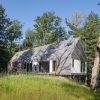
The Monica C. Gratton Library in Saint-Adolphe-d’Howard, Quebec, represents a thoughtful response to both environmental challenges and the evolving role of public institutions. Designed by Perrault Architecture, the new building aims to modernize the municipality’s cultural services while reinforcing the library as a social and civic hub. The project not only addresses flood-related concerns on the site but also introduces a welcoming public space that encourages interaction between residents, students, and visitors.
Named after Monica C. Gratton, a respected figure in the cultural life of the community, the library was conceived as a “third place” within the village—neither home nor workplace, but a shared environment for learning, conversation, and cultural discovery. Through its architectural language, Perrault Architecture seeks to create a building that reflects the identity of Saint-Adolphe-d’Howard while strengthening the vitality of the village center.
A Living Cultural Institution
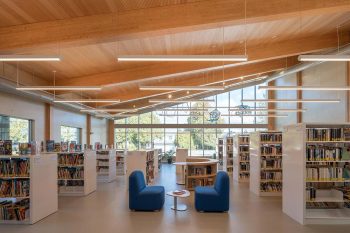
The design approach frames the library as a living institution capable of adapting to future needs. Rather than focusing on a fixed stylistic expression, the project establishes a flexible architectural framework that allows the building to evolve alongside its community. This strategy recognizes the changing nature of libraries as spaces that combine knowledge, culture, and social exchange.
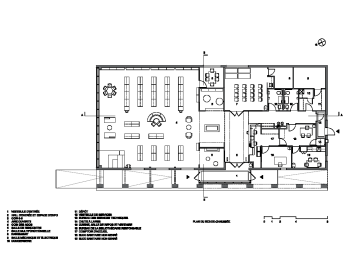
Spatial organization prioritizes openness and adaptability. Large communal areas support reading, events, and informal gatherings, while quieter zones offer more contemplative environments. The result is a community-oriented architecture that accommodates diverse activities and age groups, encouraging intergenerational connections within a shared civic space.
Architecture Inspired by Landscape

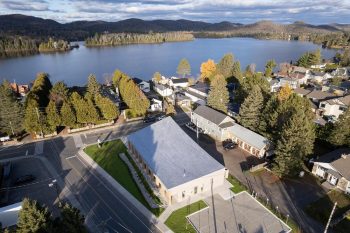
The building’s form emerges directly from the natural character of the Laurentian landscape. Mountains, lakes, and surrounding forests inform the architectural composition, giving the library a strong sense of belonging to its environment. Two distinct geometries shape the building’s silhouette: a sloping roof that echoes regional architectural traditions and a gentle curve that reflects the fluid contours of the surrounding terrain.
This combination creates a dynamic architectural presence while maintaining harmony with the village context. The roofline expresses both movement and stability, producing a dual geometric identity that changes depending on the viewer’s perspective. The building thus becomes an architectural interpretation of the region’s natural topography.
A Landmark at the Village Entrance
Located at the northern gateway of Saint-Adolphe-d’Howard, the library acts as a civic landmark within the landscape. Positioned perpendicular to the road, the building creates a welcoming forecourt that can host community events and informal gatherings. This outdoor space strengthens the relationship between the library and the daily life of the village.
The side entrance, marked by a rhythm of columns, guides visitors and nearby students toward the interior. Inside, expansive windows frame seasonal views of the surrounding forest and mountains, reinforcing the connection between architecture and nature. A warm wooden canopy structure further defines the interior atmosphere, creating a protective and comfortable environment for reading and reflection.
Energy Efficiency and Sustainable Design
Sustainability played a central role in the project, contributing to the building’s LEED Gold certification. The architectural volume remains compact and efficient, minimizing energy consumption while maintaining spatial quality. Careful orientation and generous glazing allow natural light to animate the interior throughout the year.
The distinctive roof structure combines engineered wood with tin-plated copper installed using a traditional Canadian roofing technique. Beginning at a high point and gently descending in a parabolic form, the roof creates a fluid silhouette while ensuring durability and weather resistance. Through this integration of sustainable architecture and local construction traditions, the Monica C. Gratton Library establishes a lasting civic presence for Saint-Adolphe-d’Howard.
More about the studio can be found at Perrault Architecture, whose work continues to explore the intersection of cultural identity, environmental responsibility, and contemporary architectural design.
| Technical Sheet | |
|---|---|
| Project Name | Monica C. Gratton Library |
| Location | Saint-Adolphe-d’Howard, Quebec, Canada |
| Architecture | Perrault Architecture |
| Structure and Civil Engineering | Parallele 54 |
| Mechanical / Electrical Engineering | Ambioner |
| LEED Certification | Vertima |
| Project Management | Cima+ |
| General Contractor | Groupe Laverdure |
| Photographer | Raphael Thibodeau |