Punangairi stands on the rugged West Coast of New Zealand as a seamless blend of architecture, culture, and ecology. Designed by Sheppard & Rout Architects in collaboration with Ngati Waewae, the project transforms the idea of a visitor centre into an act of cultural and environmental restoration.
Architecture Rooted in the Land

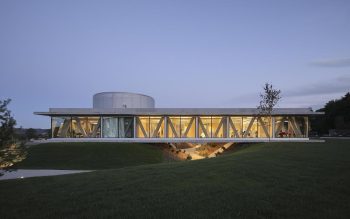
Rather than dominating its surroundings, Punangairi appears to grow from the landscape itself. The low-profile timber structure weaves among native nikau palms beneath a canopy of regenerated planting. Its green roof extends the forest ecosystem, creating continuity between architecture and nature. Every contour of the building was carefully shaped to follow the terrain, minimising ground disturbance and protecting fragile coastal ecology.
Cultural Collaboration and Authorship

The involvement of Ngati Waewae, the mana whenua (people of the land), was not symbolic but foundational. From the beginning, their guidance shaped the project’s form, materials, and spatial logic. The building embodies the Maori values of manaakitanga (hospitality) and kaitiakitanga (guardianship), transforming it into a cultural threshold rather than a tourist facility. This collaboration redefines architectural authorship as a shared process between designer and community.
Material Honesty and Sensory Connection

Inside, light filters through layered timber screens, echoing the patterns of the surrounding forest. Locally sourced timber and stone provide a tactile, grounded palette that reflects the geology and craft traditions of the region. The spatial flow moves fluidly from welcome to exhibition to reflection, inviting visitors to slow down and engage with the environment through texture, scent, and sound rather than spectacle.
Regenerative Design Philosophy

Although modest in scale, the project’s ambitions are far-reaching. Sheppard & Rout Architects applied passive design principles, low embodied carbon materials, and local craftsmanship to demonstrate that architecture can actively contribute to ecological renewal. The green roof supports native regeneration, while timber detailing expresses both technical precision and respect for natural materials. The project exemplifies a regenerative approach where environmental performance and cultural meaning are inseparable.
In essence, Punangairi is more than a visitor centre—it is a meeting point between people and place, a dialogue between built form and ancestral knowledge. Through listening to the land and those who belong to it, Sheppard & Rout Architects have created a work that redefines how architecture can care for both culture and environment.
| Technical Sheet | |
|---|---|
| Project Name | Punangairi Visitor Centre |
| Location | Punakaiki, West Coast, New Zealand |
| Completion | 2024 |
| Budget | $30 million |
| Client | Ngati Waewae (Operator/Occupant), Department of Conservation (DOC) |
| Architects | Sheppard & Rout Architects, Christchurch, New Zealand |
| Cultural Collaboration | Ngati Waewae (Poutini Ngai Tahu) |
| Project Team | Jasper Van der Lingen, Steven Orr, Max Warren, Thomas Strange, Mel North |
| Builder | Naylor Love |
| Structural Engineer | Lewis Bradford Consulting Engineers |
| Landscape Design | Kamo Marsh |
| Photographer | Jason Mann |
| Gross Floor Area | Approx. 1350 m² |
| Primary Materials | Locally sourced timber, laminated veneer lumber (LVL), glass, and green roof planting |
| Sustainability | Passive design, low embodied carbon materials, green roof regeneration, local materials sourcing |
| Awards | NZIA Nelson/Marlborough Local Architecture Award 2025, BLT Built Design Award 2025, INDE Design Award 2025, DINZ Best Award 2025 (Silver) |