The renovation of Ahof Farm shows how a listed agricultural building can be adapted for present-day living without losing its rural identity. Located in the Netherlands and shaped by the work of Flip Wentink Architecten, the project rethinks a barn from 1885 as a calm and tactile home defined by timber, lime, flax, and careful spatial restraint. Rather than turning the old structure into a polished showpiece, the design keeps its working character visible while introducing a new layer of comfort and precision. Within that balance, the intervention feels both respectful and quietly contemporary, with EeStairs contributing the project’s most expressive architectural gesture.
A barn preserved through material honesty
What makes this project compelling is its refusal to overwhelm the original building. The old barn remains legible through its steep roof, exposed structure, handcrafted thatch, and large glazed doors with traditional shutters. The renovation relies on natural materials that feel consistent with the building’s age and atmosphere, especially timber, lime plaster, and flax-based construction elements. These choices do more than reduce environmental impact. They also help create an interior that feels breathable, grounded, and visually quiet.
Instead of layering the rooms with decorative excess, the design uses emptiness and texture as its primary tools. Walls and surfaces remain restrained, allowing the grain of wood, the softness of plaster, and the weight of the historic envelope to carry the experience. This gives the house a sense of clarity that is rare in adaptive reuse projects, where old buildings are often overworked in the name of novelty.
The pine staircase as the spatial centerpiece
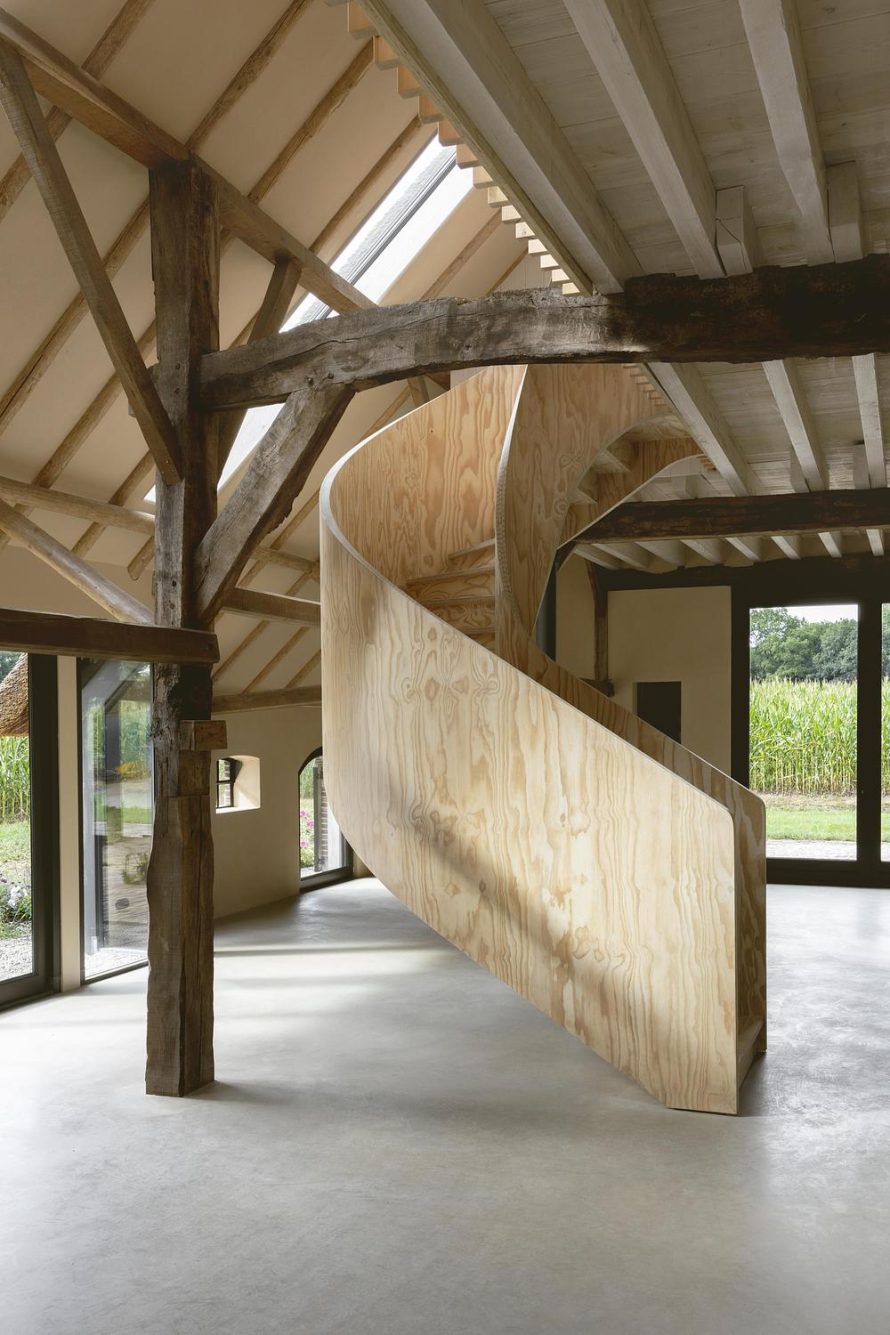
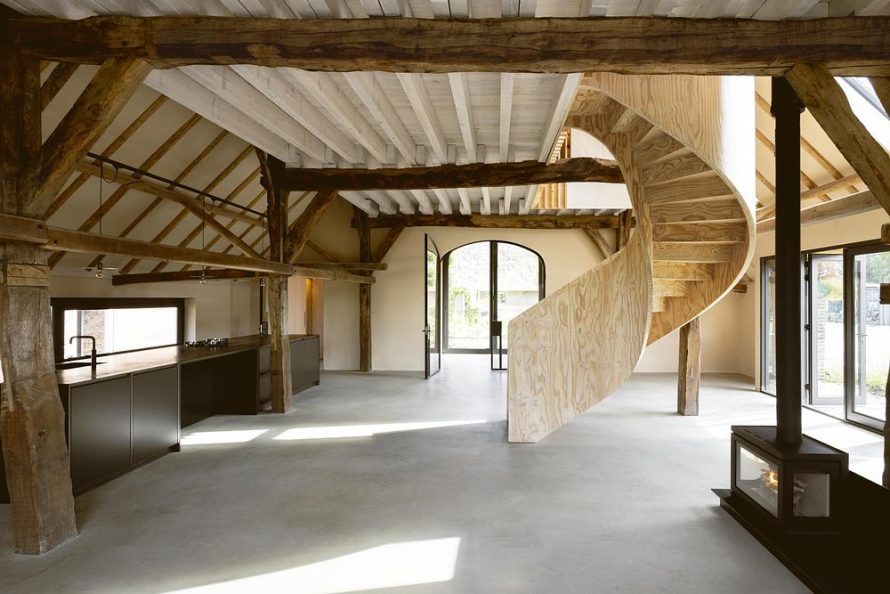
At the center of the conversion is a sculptural spiral stair in pine plywood, developed through a collaboration between the interior architect and EeStairs. Its form is immediately striking, yet its material language keeps it connected to the barn. The stair does not imitate luxury finishes or historic ornament. Instead, it embraces a raw and almost workshop-like appearance, making it feel entirely appropriate within the former agricultural shell.
Its strongest quality is the way it appears self-supporting. With no central column interrupting the composition, the stair rises as a smooth helical ribbon that draws the eye upward. The detailing is equally important: the balustrade, underside of the treads, and exposed plywood edges are resolved with impressive precision. The result is a staircase that functions like a piece of inhabitable craftsmanship rather than a decorative insert.
A contemporary home inside a historic shell
The reorganization of the barn allowed a first floor to be introduced, creating space for bedrooms and bathrooms without disturbing the architectural calm of the main volume. The layout supports modern domestic life, but it does so quietly. Circulation remains fluid, light moves freely from one end of the building to the other, and the old proportions still shape the lived experience.
Interior architect Julia van Beuningen adds a subtle contrast through elements such as the steel kitchen island and polished concrete floor. These gestures bring a lightly industrial note into the project, but never dominate it. Against those cooler surfaces, the pine used in the stair, balustrade, and upper-level partitions adds warmth and visual softness, helping the interior feel both functional and welcoming.
Low-impact renovation with long-term value
Ahof Farm is also notable for its environmental ambition. The barn was renovated as a zero-consumption home, where energy-efficient systems and renewable energy production are balanced against the building’s needs. That target is particularly meaningful in a heritage project, where sustainability is too often discussed only in terms of appearance instead of long-term performance.
More importantly, the project suggests a broader lesson for rural renovation. Sustainability here is not expressed through visual technology or obvious green branding, but through material restraint, building reuse, and durable craftsmanship. In that sense, Flip Wentink Architecten delivers a project that bridges centuries with unusual confidence. The barn remains unmistakably old, yet fully capable of supporting a new domestic life, while EeStairs gives the transformation its most memorable architectural moment.
Technical Sheet
| Category | Details |
|---|---|
| Project Name | Ahof Farm |
| Location | Nijkerk, Netherlands |
| Project Type | Residential Architecture / Barn Renovation |
| Architect | Flip Wentink Architecten |
| Interior Architect | Julia van Beuningen |
| Staircase Design and Fabrication | EeStairs |
| Completion Date | September 2022 |
| Construction Duration | 18 months |
| Gross Internal Floor Area | 162 m2 |
| Total Site Area | 791 m2 |
| Main Materials | Timber, lime, flax, pine plywood, polished concrete, thatch |
| Google Maps | Nijkerk, Netherlands |