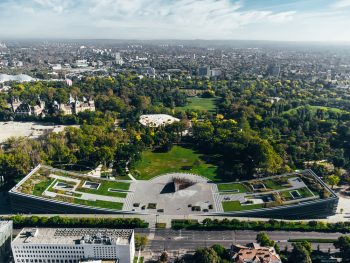
The Brise-Vent Havre Harbor Museum by LYT-X Studio proposes a civic cultural destination along the historic waterfront of Le Havre, France. Instead of treating the former harbor structure as a sealed relic, the concept reframes it as usable infrastructure for public culture, where circulation, outdoor rooms, and new program can coexist with the site’s industrial memory.
From Port Infrastructure to Civic Cultural Ground

Set within a former port zone once central to maritime operations, the existing structure gradually lost its function as harbor activity evolved. The proposal answers that shift by keeping the building as the primary historical layer while inserting contemporary elements that expand its capacity for cultural use and public access. The intention is not to disguise the past, but to let old and new remain readable as interconnected parts of one framework.
By approaching the building as a spatial resource, the project positions adaptive reuse as an urban tool rather than a conservation exercise. The harbor edge becomes part of the city’s daily routes again, supporting informal occupation as much as scheduled events.
A Continuous Sequence Between City and Harbor

The museum is organized around movement across and through the site, connecting the city promenade, the waterfront edge, and the harbor beyond. Rather than concentrating activity in a single enclosed volume, public circulation is distributed so the project participates in the broader waterfront network. This creates a museum that behaves like public space first, and an institution second.
Views toward the water are used as orientation, reinforcing the relationship between interior cultural programs and the maritime context outside. The result is a spatial sequence where the waterfront is not an “arrival moment,” but an everyday passage.
The Canopy as Urban Threshold

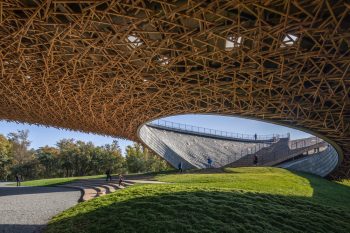
A defining move is the extension of the existing curved roof into a continuous canopy along the waterfront edge. The canopy structures circulation, provides passive shading, and shapes semi-open outdoor rooms that mediate between urban pathways and harbor activity. Beneath it, sheltered public areas and a courtyard allow multiple access points from both the city and the water.
Public accessibility is treated as a core design parameter. The courtyard is intended to remain open beyond museum operating hours, letting the site function as a civic connector rather than a closed destination. Thresholds between inside and outside are defined through spatial continuity, not just transparency.
Flexible Program and Environmental Logic

The program includes permanent and temporary exhibition halls, a performance hall, flexible event spaces, and outdoor public areas tied to the dock. This mix supports different cultural formats while keeping the building adaptable over time. Circulation is organized for clear wayfinding, with interior spaces aligned to the harbor to maintain contextual awareness.
Environmental strategies are embedded through reuse and restraint. Retaining the structure reduces new construction, while the extended roof canopy supports shaded microclimates along the waterfront. Courtyards and roof openings bring in daylight, and ventilation is designed to leverage coastal air movement for passive comfort.
Developed within LYT-X Studio, the project’s architectural position was structured with founder Dingdong Tang alongside co-founders Zehui Li and Haisheng Xu, translating heritage, access, and long-term urban use into spatial systems.
Technical Sheet
| Item | Description |
|---|---|
| Project Name | Brise-Vent Havre Harbor Museum |
| Location | Le Havre, France |
| Design Year | 2024–2025 |
| Status | Concept Stage |
| Program | Museum (permanent and temporary exhibition halls), performance hall, public plaza, waterfront dock, flexible event and cultural spaces |
| Gross Floor Area | 31,000 m² |
| Site Area | Harbor redevelopment site (existing industrial waterfront structure) |
| Floors | 4 levels (including 1 underground level) |
| Building Height | 24 m |
| Structure | Steel and reinforced concrete |
| Facade / Envelope | Glass curtain wall system with extended curved roof canopy |
| Design Team | Dingdong Tang, Zehui Li, Haisheng Xu |