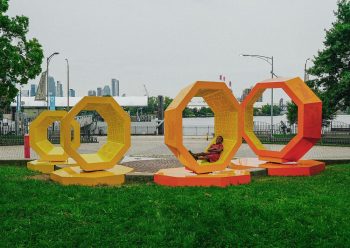
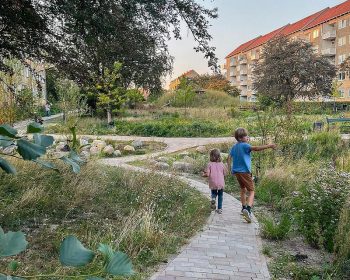
Cishan Tribe is what happens when a city decides kids deserve more than plastic castles and loud colors. Designed by XISUI Design, this public playscape sits on the sloped plaza in front of Handan MixC One Mall, turning a 3,200-square-meter urban site into a landscape that can be climbed, explored, and occupied.
The concept draws directly from Handan’s deep timeline, particularly the 8,000-year-old Neolithic Cishan culture. Instead of treating archaeology as static history, the project transforms cultural symbols into physical play elements that are intuitive for children and meaningful for the city.
From Neolithic roots to everyday city life

Handan is often described through its long urban history, but Cishan Tribe looks further back to the region’s earliest agricultural origins. The design treats cultural heritage as lived experience, embedding it into daily routines rather than isolating it behind signage or museum walls.
Located beside a major commercial complex, the space is free, open, and highly accessible. This positioning ensures the playground functions as everyday civic infrastructure rather than a destination used only on special occasions.
A plaza that performs like a landscape playground

The naturally sloped site defines the spatial experience. Movement replaces rigid circulation, allowing children to navigate through paths, platforms, and pockets that reveal changing viewpoints across the plaza. Parents benefit from clear sightlines, while kids gain freedom to invent their own routes.
Material choices emphasize tactility and durability. Natural wood, stone, and wood-plastic composites give the playground a grounded presence that avoids the glossy, theme-park aesthetic common to many urban play spaces.
Installations that turn symbols into actions

Each major element functions as both symbol and play equipment.
The egg-hatching chicken structure combines slides, climbing nets, tunnels, and lookout points into a single form, reinforcing the idea of multi-functional play rather than isolated activities.
At the entrance, the Millet Arch acts as both gateway and sensory device, incorporating recognition elements and kaleidoscopic views. The Walnut Seat operates as a social anchor, offering seating, resting nets, and informal gathering points without becoming a staged photo object.
Why it works as a civic space
Cishan Tribe balances the needs of children, caregivers, and the surrounding city. Kids find challenge and discovery, adults gain comfort and visibility, and the urban context receives a clear yet restrained visual identity.
By maintaining a consistent design language across varied play elements, the project avoids visual clutter. Ultimately, XISUI Design transforms history into an everyday experience, where cultural memory is reinforced through repetition, play, and shared use.
| Technical Sheet | |
|---|---|
| Project Name | Cishan Tribe: Where 8000-Year Cultural Relics Encounter Public Children’s Space |
| Location |
MixC One Plaza, No. 277 Lianpo North Street, Economic Development Zone, Handan, Hebei, China Google Maps |
| Client | China Resources Land Ltd. |
| Chief Designer | Hu Yihao |
| Project Manager | Peng Yang |
| Design Team | XISUI Design |
| Designers | Li Chengxi; Liu Yihe; Zheng Mengzi; Chen Wenqi; Chu Tiancheng; Ruan Chengxin; Cai Jiangang |
| Construction Firm | Shanghai Lucqplay Facilities Co., Ltd |
| Structural Consultant | Spiring Architectural Design |
| Site Area | 3,200 sqm |
| Budget | CNY 3,000,000 |
| Completion Date | 30 April 2024 |
| Photographer | Hu Yihao; XISUI Design; FOLOR Studio |
| Video | XISUI Design |