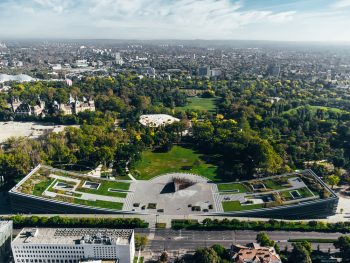
The Nokha Village Community Centre, designed by Sanjay Puri Architects, is located in the desert landscape of Nokha, Rajasthan. Conceived as a memorial for Padmaramji Kularia, the project responds to both an emotional brief and a clear social gap within a district of 144 villages lacking shared cultural infrastructure. Sanjay Puri Architects approach the project not as a singular object, but as a terrain-driven civic landscape shaped by climate, community use, and movement.
Architecture as a Continuous Landscape

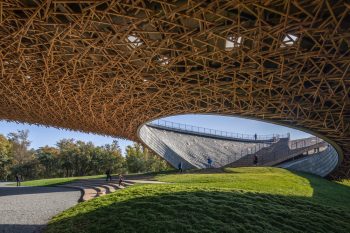
The defining gesture of the project is its sweeping spiral form that rises from the northeastern corner and loops around the site, shaping a north-facing courtyard at its center. Rather than placing landscape around the building, the architecture itself becomes an inclined garden. This 9,000 sq.ft structure generates an equal amount of usable rooftop green space, blurring the boundary between built form and open ground.
The sloping roof functions as a public terrain, allowing informal gatherings, play, and viewing points overlooking the surrounding desert. This continuity of movement reinforces the idea of architecture as a social connector rather than a static enclosure.
Program Beneath the Garden

Beneath the inclined landscape sits a compact yet layered program. A small museum is embedded on the eastern side, while a children’s digital library occupies the higher western portion. These spaces are carefully tucked under the roof garden, benefiting from thermal insulation while remaining visually and spatial connected to the exterior.
The central courtyard doubles as an open-air amphitheatre, creating a venue for music, talks, and village gatherings. This courtyard becomes the social heart of the project, naturally ventilated and shaded, encouraging daily and seasonal use across age groups.
Climate-Responsive Design in the Desert

With temperatures reaching 35–40°C for most of the year, climate responsiveness drives every design decision. The southern facade is protected by a grass-covered earth berm, reducing heat gain and buffering the interior spaces from harsh solar exposure.
The ovoid library volume is wrapped in locally sourced sandstone screens, inspired by traditional Rajasthani architecture. These perforated stone layers filter daylight, reduce heat, and cast changing shadow patterns throughout the day, creating a calm, readable interior environment for learning.
Efficiency, Craft, and Community Value

Despite its modest scale, the project produces a total of 36,000 sq.ft of usable space when including the rooftop garden and amphitheatre. This fourfold spatial efficiency demonstrates how thoughtful section design can amplify public value without increasing built mass.
Rainwater harvesting, water recycling, and the use of local materials and craftsmen ensure the building remains sustainable both environmentally and economically. The project reflects Sanjay Puri Architects’ consistent approach: contextual forms, passive climate strategies, and architecture that quietly serves its community.
| Technical Sheet | |
|---|---|
| Project Name | Nokha Village Community Centre |
| Location | Silwa-Mulwas, Nokha, Rajasthan, India |
| Client | Padam Interiors |
| Start Date | April 2022 |
| Completion Date | February 2024 |
| Gross Floor Area | 13,000 sq.ft (810 sqm) |
| Rooftop Garden Area | 9,000 sq.ft |
| Open Amphitheatre Area | 27,000 sq.ft |
| Architect | Sanjay Puri Architects |
| Lead Architect | Sanjay Puri |
| Design Team | Omkar Rane, Madhavi Belsare, Arjun Gupta |
| Structural Consultant | Vijaytech Consultants Pvt. Ltd |
| Main Contractor | Jagram Suthar |
| Photography | Vinay Panjwani |