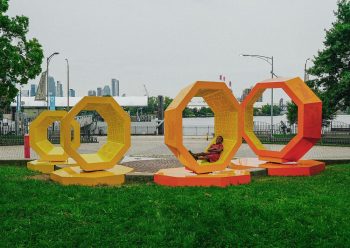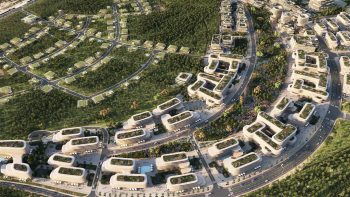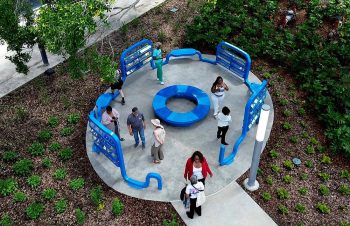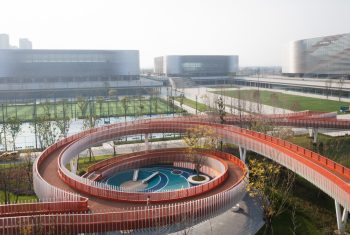


In San Francisco’s ever-evolving Mission Rock neighborhood, public space is undergoing a quiet yet powerful transformation. At the heart of this shift is Min Design, a studio known for its hybrid approach to architecture, landscape, and art. Led by E.B. Min, the firm brings a tactile sensitivity to urban life—where concrete becomes part of a landscape, and a simple canopy structure becomes a space for pause, shade, and gathering. Their latest two projects, China Basin Park Restroom and The Garden Party, offer a window into how thoughtful design can shape civic life in playful, unexpected ways.
The Architect: E.B. Min’s Cross-Disciplinary Approach
E.B. Min, the founding principal of Min Design, brings more than just architectural training to her work. With roots in both art history and studio art from Brown University and architectural training from UC Berkeley, her process often straddles form and function. Her early experience in landscape architecture shapes her sensibility: buildings don’t stand apart from nature—they coexist. This shows in her studio’s projects, which rarely separate object from environment. In a city like San Francisco, where public space is at a premium, this contextual approach feels less like an aesthetic choice and more like a civic responsibility.
The China Basin Restroom: Elevating a Civic Basic
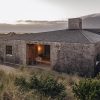
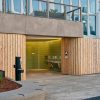
On paper, designing a public restroom might not sound like a thrilling commission. But Min Design took this as a chance to elevate infrastructure into architecture. Set in a five-acre waterfront park designed for activity and leisure, the China Basin Park Restroom is an all-gender facility that is as discreet as it is dignified. The form tucks naturally into the surrounding park, and its material palette—custom-colored concrete, sustainable greywater systems—echoes the landscape’s earthy tones.
The jury for the AIASF Design Awards praised it as “a small but dignified civic structure,” underscoring how civic architecture can be both utilitarian and beautiful. It’s a space designed not to be noticed for what it is, but for how seamlessly it supports its surroundings.
The Garden Party: A Canopy for Pause and Play
Just a few blocks away, The Garden Party takes a more expressive form. Designed as a temporary public art pavilion, it bridges landscape, sculpture, and architecture. Inspired by greenhouses and Victorian conservatories, the gently curving frame and open lattice work invite pedestrian movement while offering a defined gathering space.
Rather than imposing itself, the structure wraps around two existing trees, allowing the canopy to evolve organically as the trees mature. It’s a design that’s not afraid to be graceful or temporal—light, unassuming, and meant for the in-between moments of city life: a coffee, a chat, a moment of shade.
Design as Civic Gesture
What binds these two projects isn’t just their proximity or shared authorship—it’s their attention to public ritual. Restrooms and street pavilions rarely get architectural attention. But by bringing clarity, precision, and a touch of delight to these small civic gestures, Min Design suggests that the most meaningful design doesn’t always announce itself. Sometimes, it simply makes public life a little more livable.


Technical Sheet
| Project | Details |
|---|---|
| China Basin Park | |
| Facilities Design | Min Design |
| Landscape Architecture | SCAPE |
| Collaborators | Miller Company, Pine & Swallow, Pannu Larsen McCartney, BKF Engineers, Urban Design Consulting Engineers, Langan, Brookwater, Peterson Associated Engineers, Webcor, PritchardPeck Lighting |
| Floor Finish | Concrete with custom color and aggregate to match the landscape |
| The Garden Party | |
| Facilities Design | Min Design |
| Landscape Architecture | CMG |
| Fabricator | One Hat One Hand |
| Size | Plan footprint: 16′-6″ x 30′ Height varies: 11′ at highest, 8′-8″ head clearance at entrance arch |