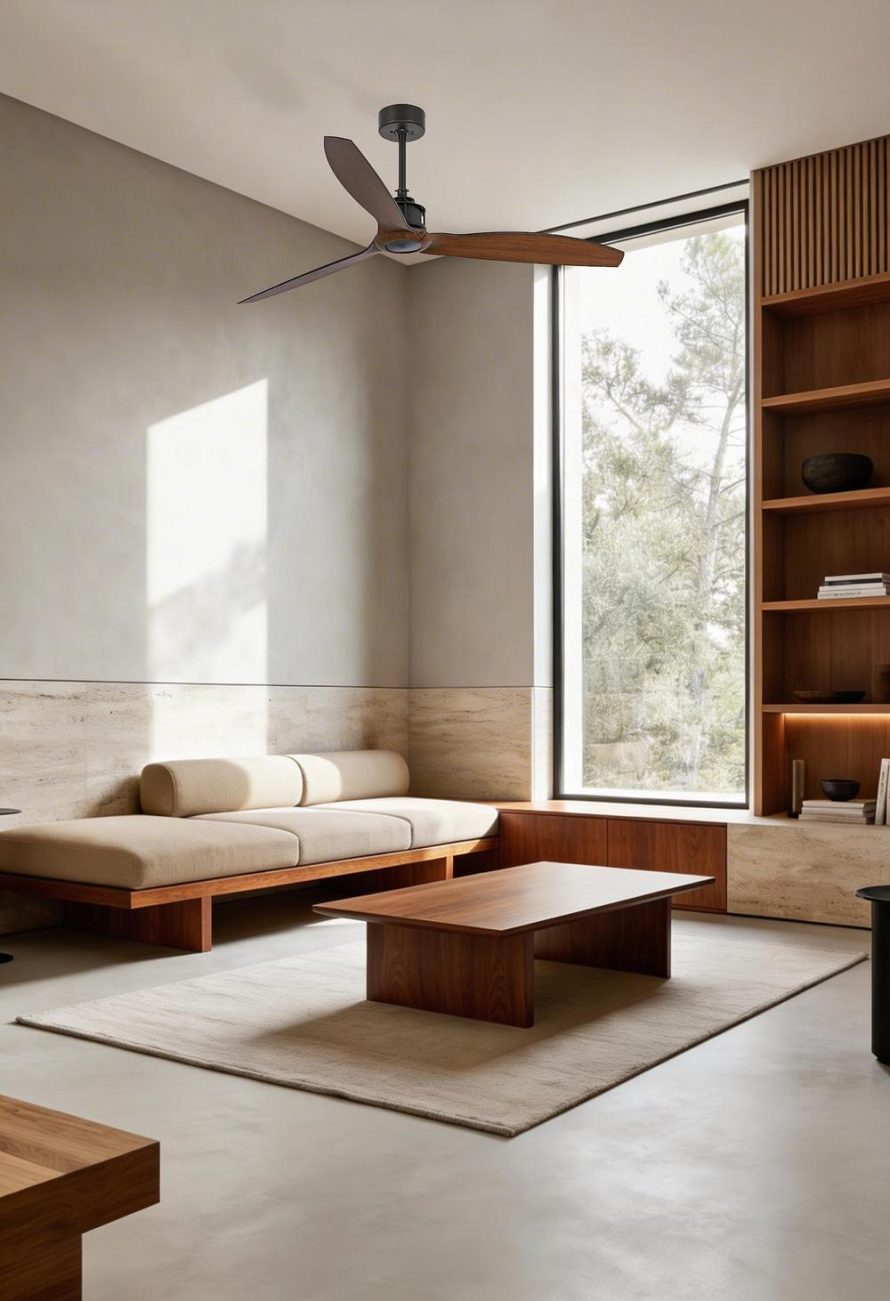
For a long time, the ceiling fan occupied an awkward place in the home. It was useful, certainly, but rarely discussed in the same breath as architecture, interior design, or environmental strategy. That perception is shifting. In today’s American interiors, where spatial clarity, energy performance, and everyday wellbeing increasingly guide specification, ceiling fans are returning as purposeful design tools. In that shift, Faro Barcelona is positioning itself not simply as a manufacturer, but as a company shaping how modern ventilation is understood in design culture.
Founded as a lighting workshop and later expanding into ceiling fans, Faro Barcelona has built its reputation through a long-term focus on air movement, integrated engineering, and quiet usability. Rather than presenting ventilation as a secondary technical layer, the brand frames it as part of the lived atmosphere of a room: something that affects comfort, mood, and environmental performance at once.
Reconsidering the role of the ceiling fan
What makes this moment interesting is not just the return of the fan, but the context around it. Designers are under increasing pressure to create spaces that feel comfortable while also reducing dependence on energy-intensive systems. In that discussion, the ceiling fan becomes more than a nostalgic object. It becomes a low-energy, high-impact tool for improving thermal comfort and reducing HVAC demand.
Faro Barcelona argues for the fan as an architectural component rather than an accessory. That distinction matters. A well-designed fan does not merely move air. It contributes to how a room is used, how quiet it feels, how the ceiling is read visually, and how efficiently a space performs throughout the year.
Performance that supports everyday comfort

At the center of Faro Barcelona’s message is measurable efficiency. Its fans use advanced DC motor technology, consuming an average of just 15W while delivering airflow of up to 6,000 CFM. The result is a perceived temperature reduction of around 2 to 4 degrees Celsius, achieved not by forcing cold air but by improving air circulation and creating a softer, more natural breeze effect.
That approach also changes the seasonal logic of the product. In warmer months, the fan supports cooling comfort with very low energy use. In colder months, reversible motor functions help redistribute warm air trapped near the ceiling, improving the overall efficiency of heating systems. For residential interiors, that translates into year-round usefulness rather than a strictly summer-only appliance.
Just as importantly, the near-silent performance of DC technology makes these products suitable for bedrooms, open-plan living areas, hospitality projects, and other environments where acoustics matter as much as airflow.
Sustainability beyond aesthetics

Faro Barcelona’s positioning also responds to a broader shift in the design industry: sustainability is no longer a branding layer added at the end of development. It is increasingly expected to shape materials, energy consumption, durability, and lifecycle thinking from the beginning. Here, the company ties sustainable design to both engineering decisions and sourcing practices.
Its wooden fan models use FSC-certified material, while its low-consumption motors reduce operational energy significantly over time. According to the figures shared in this release, annual energy consumption averages 10.4 kWh, compared to 392 kWh for a comparable air-conditioning system under the same usage pattern. The argument is straightforward: in moderate climates, or as part of a hybrid comfort strategy, the ceiling fan can play a serious role in lowering carbon impact.
The company further reinforces that message through its environmental certifications and lifecycle-oriented approach, including repair and refurbishment initiatives that extend product usefulness rather than encouraging rapid replacement.
Technology, hospitality, and specification appeal
One of the more convincing aspects of Faro Barcelona’s position is that it does not separate design from usability. Across its collections, features such as remote operation, smart-control compatibility, reversible airflow, slope adaptability, and integrated LED options are treated as part of one coordinated system. In other words, ventilation, illumination, and daily interaction are designed to work together.
This is especially relevant in contemporary specification culture, where architects and interior designers are expected to balance appearance, compliance, flexibility, and performance. Faro Barcelona points to use by major hospitality groups as further evidence that its products are not niche decorative objects, but robust solutions capable of meeting both aesthetic and operational expectations.
In that sense, Faro Barcelona is not really trying to make the fan fashionable. It is doing something more interesting: making the fan legible again as a serious design element. For an industry increasingly focused on comfort with lower environmental cost, that is a timely proposition. Faro Barcelona presents ventilation not as background equipment, but as part of the architecture of everyday life. Pricing and market availability were not detailed in the release, but the broader direction is clear: Faro Barcelona wants the ceiling fan to be seen, specified, and evaluated with the same seriousness as any other interior component.
| Technical Specs | |
|---|---|
| Brand | Faro Barcelona |
| Article Focus | Ceiling fan collection / modern ventilation solutions |
| Category | Product, Industrial Design, Lighting Design, Residential Interior Design |
| Market Focus | American market |
| Motor Type | Advanced DC motor technology |
| Average Power Consumption | 15W |
| Maximum Airflow | Up to 6,000 CFM |
| Perceived Temperature Reduction | Approx. 2-4°C |
| Annual Energy Consumption | 10.4 kWh (fan) vs 392 kWh (comparable AC reference) |
| Estimated Carbon Impact | Up to 97% lower than comparable AC use case |
| Seasonal Function | Reversible airflow for summer and winter use |
| Controls | Remote and smart-control compatibility |
| Additional Options | Integrated LED solutions, slope adaptability |
| Certification | ETL-certified models for U.S. compliance; FSC-certified wooden models |
| Sustainability Notes | Lifecycle analysis, repair and refurbishment initiatives, lower operational energy demand |
| Official Website | Faro Barcelona |