At the western gateway of Waterloo, Quebec, the new Sûreté du Québec police station designed by STGM Architecture in consortium with CIMAISE stands at the edge of farmland and urban fabric. Completed in 2025, the project demonstrates how contemporary institutional architecture can reconcile strict security requirements with environmental sensitivity and civic presence.
Strategically located within previously disturbed land, the building avoids encroaching on nearby wetlands and wooded areas. This approach reflects a commitment to responsible land management, minimizing ecological impact while reinforcing the transition between the rural Montérégie landscape and Waterloo’s urban core.
Dialogue with the Montérégie Landscape
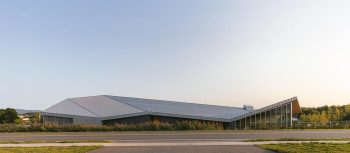
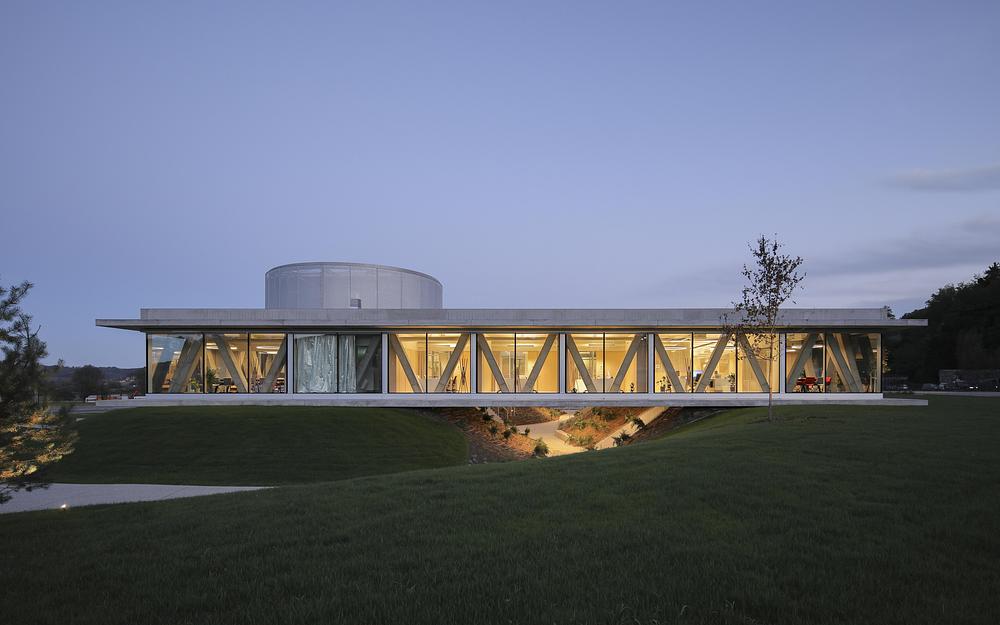
The surrounding hills of Montérégie, particularly Mount Shefford, directly influenced the building’s massing and architectural language. Roof modulation and sculpted volumes respond to the local topography, allowing the facility to resonate with its natural surroundings.
Openings and glazing are carefully positioned to frame distant views, establishing a continuous visual exchange between interior spaces and the landscape. This emphasis on visual continuity reinforces the relationship between the civic institution and the territory it serves.
Clear Functional Hierarchy and Security

The interior organization is structured around a precise hierarchy of spaces. Public zones, staff areas, and secure sectors are clearly separated to ensure operational efficiency and compliance with security requirements.
Façade treatment reflects this layered logic. While secure areas remain discreet and protected, public-facing zones maintain appropriate transparency. The architecture balances openness and protection, avoiding the defensive image often associated with institutional buildings.
Spatial Quality and Well-Being

The main entrance is defined by a wood-clad canopy and generous glazing oriented toward Mount Shefford. This civic gesture establishes a welcoming threshold while reinforcing a strong connection to landscape.
Inside, wood finishes and abundant natural light enhance comfort and orientation. A skylight in the entrance hall amplifies daylight, while frequently occupied workspaces are oriented north and northwest to ensure consistent illumination without glare or excessive heat gain.
Environmental Performance and Durability

Targeting LEED certification, the project integrates structural and technical strategies focused on long-term performance. A hybrid steel and wood structure reduces embodied carbon while accommodating functional constraints and operational demands.
The envelope follows the perfect wall principle, ensuring continuous insulation and air barriers to minimize thermal bridging and improve energy efficiency. Designed for adaptability, the restrained architectural language allows the building to respond to the evolving needs of the Sûreté du Québec without major structural interventions.
The Sûreté du Québec police station in Waterloo reflects the integrated design philosophy of STGM Architecture, demonstrating that high-security institutional buildings can remain environmentally responsive, context-sensitive, and human-centered.
| Technical Sheet | |
|---|---|
| Official Project Name | Sûreté du Québec Police Station – MRC de la Haute-Yamaska |
| Location | Waterloo, Quebec, Canada |
| Client | Société québécoise des infrastructures / Sûreté du Québec |
| Architect | STGM Architecture (Consortium with CIMAISE) |
| Design Lead | Alexandre Guerin |
| Principal Architects | Guillaume Robin / Alexandre Freniere |
| Interior Design | Zoe Riou |
| Engineers | Cote Jean (Structure-Civil), WSP (MEP) |
| Contractor | Alain Lizotte Construction |
| Budget | 16.5 M CAD |
| Delivery | 10 September 2025 |
| Photography | Raphael Thibodeau / Alexandre Guerin |